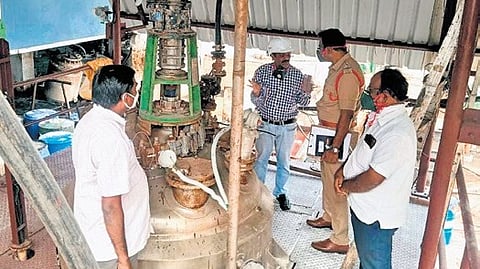

VISAKHAPATNAM: A preliminary investigation conducted on November 27 by the Joint Chief Inspector of Factories, Visakhapatnam, and the Deputy Chief Inspector of Factories, Vizianagaram, has uncovered several safety violations at Tagoor Laboratories Private Limited, Unit-III, Parawada in Anakapalle. The investigation followed a toxic gas leak on November 26 that resulted in the death of two workers and the hospitalisation of eight others.
The probe revealed that the accident occurred during the manufacturing of Lamivudine when a mixture of hydrochloric acid (HCL) and chloroform spilt from reactor GLR325 due to pressurisation caused by the rapid addition of HCL. The absence of a feed control system was identified as a key factor. Workers neutralised the spill with soda ash but lacked appropriate respiratory protective equipment, leading to toxic vapour inhalation and subsequent health complications.
According to the report, key safety lapses identified during the probe include the absence of a Hazard Analysis and Quantitative Risk Assessment (HARA) and a Hazard and Operability (HAZOP) Study for Lamivudine production. Additionally, adequate personal protective equipment (PPE) for workers, a proper feed control system, and essential safety mechanisms such as safety relief valves (SRV) and rupture discs (RD) were missing. The factory also lacked an effective scrubbing system to manage hazardous chemical releases and detectors with alarms to warn workers of toxic vapour leaks.
Given these violations, authorities issued prohibitory orders under Section 40(2) of the Factories Act, halting all manufacturing operations at the facility with immediate effect. The orders mandate the implementation of several safety measures, including updated HARA and HAZOP studies conducted by expert agencies, the provision of adequate PPE, the installation of feed control systems, and the addition of SRVs, RDs, and scrubbing systems to reactors. Chemical detectors with alarm systems must also be installed at strategic locations to safeguard workers. The prohibitory orders will remain in effect until the factory demonstrates compliance with these safety requirements.