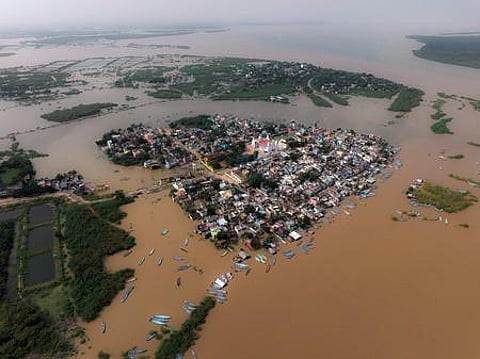

VISAKHAPATNAM: Visakhapatnam has been selected under Phase-II of the Urban Flood Risk Mitigation Programme (UFRMP) of the National Disaster Management Authority (NDMA), with an allocation of Rs 200 crore.
The initiative, sanctioned by the Central Finance Commission, aims to strengthen the city’s resilience against flood-related disasters through structural and non-structural measures.
A total of Rs 2,444.42 crore has been sanctioned for 11 cities, with the Centre contributing Rs 2,200 crore, and the States providing Rs 244.42 crore as their share.
Each city will implement projects with 90% funded by the Centre, and 10% by the respective State governments. The programme was recently approved by a high-level committee chaired by Union Home Minister Amit Shah.
Greater Visakhapatnam Municipal Corporation Commissioner Ketan Garg said, “GVMC will implement the UFRMP. We have two components under this project with structural solutions estimated at Rs 140 crore, and non-structural interventions worth Rs 60 crore.”
The project has been designed with multiple objectives, including conducting studies to assess urban flood hazards, mapping vulnerable areas, developing projects that use structural, non-structural, and nature-based solutions, strengthening early warning and emergency response systems, and engaging communities in disaster risk reduction and climate change adaptation activities.
The proposed structural interventions include the development and upgradation of storm water management systems (Rs 80 crore), rejuvenation of water bodies and cascading of lakes with Rs 24 crore, construction of walkways and road curbs with permeable materials with Rs 10 crore, development of sponge parks and sponge zones with Rs 6 crore, rainwater harvesting initiatives with Rs 5 crore, and pilot bioswale projects as a combination of structural and non-structural solutions worth Rs 15 crore.
The non-structural interventions proposed under the programme include the creation of green spaces, green roofs, and urban forests with Rs 20 crore, development of GIS and IT-based flood monitoring and early warning systems with Rs 20 crore, training programmes for officials and staff with Rs 5 crore, community-based disaster risk management in flood-prone areas with Rs 5 crore, hazard and vulnerability assessments with Rs 2 crore, preparation of city and ward-level disaster management plans with Rs 2.5 crore, and setting up an urban flood management cell as part of the city’s disaster management system with Rs 5.5 crore.
The proposal also includes framing or amending building bylaws to strengthen flood resilience, Garg told TNIE.
The 11 cities identified under this phase are Bhopal, Bhubaneswar, Guwahati, Jaipur, Kanpur, Patna, Raipur, Thiruvananthapuram, Visakhapatnam, Indore and Lucknow. They were chosen on the basis of being highly populated State capitals or major cities prone to flooding, with additional consideration of environmental, socio-economic, and hydro-meteorological factors.
