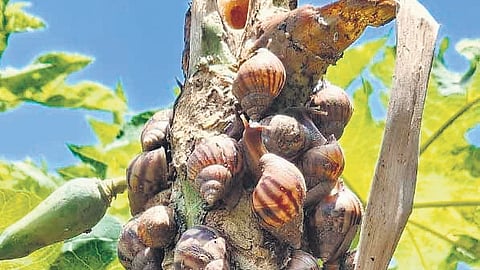

VIZIANAGARAM: In the fertile fields of Komarada mandal in Parvathipuram-Manyam district, a silent invader is wreaking havoc. The giant African snail, the invasive species, has suddenly appeared, devouring horticultural crops, and causing huge loss to farmers.
Already reeling under wild elephant menace, farmers now face an escalating threat as these snails spread rapidly, even infiltrating homes. “The farmers first noticed the snails in their fields in June, and neglected them as they thought these were white garden snails, which are common during the rainy season, and not harmful for crops,” said a horticulture official.
But as the numbers surged, experts confirmed them as giant African snails, notorious for attacking fresh leaves, and young shoots. Ravikarravalasa, Gangireguvalasa and Gadabavalasa villages have been hit hard in recent days. Crops, including papaya, guava, chrysanthemum, tomato, ladyfinger, cabbage, and other vegetables, are being destroyed by the snails on a vast scale.
Community efforts stressed to offset threat of snails to horticulture
Farmers suspect floodwaters from Odisha brought the species, but officials blame larvae in areca nut saplings imported from Kerala for intercropping for the snail invasion.
“Our primary findings revealed that the giant African snails arrived in Manyam district through the areca nut saplings, which the farmers imported from Kerala to cultivate as an intercrop. When we identified these snails in Salur region a couple of years ago, we took several measures for their prevention. Now, the climatic conditions are very suitable in Komarada for the breeding of the snail. Hence, the snails are multiplying rapidly, damaging the horticulture crops on a large scale,” District Horticulture Officer K Satyanarayana Reddy told TNIE.
Saibabu, a farmer from Gangireguvalasa, shared that he has been cultivating papaya, guava and chrysanthemum in his five acres of land, investing lakhs of rupees. “The number of snails is increasing day by day, and they are devouring my crops. The papaya crop has been badly damaged. We have tried to collect the snails by hand, and destroy them as per the horticulture officials’ suggestion. However, we need to spend a lot towards wages of labourers for collection of snails,” he said, underlining the need for government intervention to protect the crops.
“The giant African snails arrived in Kerala 100 years ago from East Africa. The egg-laying capacity of the snail species is 1,000 per year, and its lifespan is five years. We do not have effective predators to control the breeding of snails. As the climatic conditions are very suitable for the breeding of the snail, its population has increased rapidly,” explained NBV Chalapathi Rao, principal scientist at YSR Horticulture University.
Stressing the need for community efforts to face the threat, he said, “We should prevent spreading of the snails by keeping gunny bags with rock salt on the bunds in the fields. Cabbage leaves can also be kept on the gunny bags as bait. We can also prevent these snails by using Metaldehyde pellets.”
Though District Collector A Shyam Prasad has directed horticulture officials to step up efforts to control the spread of snails, experts underlined the need for sustained action to combat the threat.
