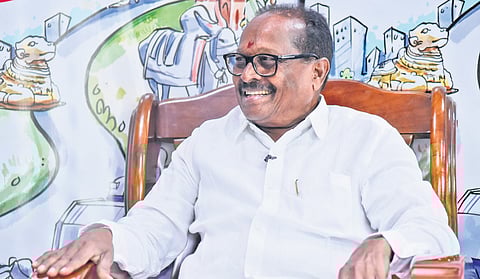

In the second episode of TNIE AP Dialogues, APSRTC Chairman Konakalla Narayana Rao shares his thoughts with BSN Malleswara Rao, S Viswanath, Phanindra Papasani and Y Brahmaji. Excerpts:
It has been eight months since the launch of the ‘Stree Shakti’ scheme, and the passenger response has far exceeded expectations. As Chairman of APSRTC, do you see this primarily as a major success or a serious operational challenge?
We are very pleased to have successfully implemented the scheme, fulfilling the promise made under the TDP’s ‘Super Six’ poll commitments. During its rollout, we observed two key aspects-high public satisfaction and certain operational challenges. The scheme’s success surpassed our expectations, and APSRTC is addressing the gaps to ensure its smooth and uninterrupted functioning.
Initially, there was criticism that the ‘Stree Shakti’ scheme could push APSRTC into deep losses or even lead to privatisation. Now, with its extension to the physically challenged, revenue has further reduced. The Rs 1,942 crore annual estimate was reportedly exhausted within eight months. How is the corporation sustaining the scheme?
This is not a burden on RTC. It is a burden on the Government. RTC is only a service provider, and the Government is reimbursing the amount being spent on the Stree Shakti scheme. Initially, we estimated the annual cost of the scheme at Rs 2,000 crore. However, as of today, just 7 months and 15 days after its launch, the expenditure has crossed Rs 1,950 crore. Women are using the buses far more frequently than we expected.
Before the scheme was implemented, the Occupancy Ratio (OR) was around 65 per cent. It has now risen to over 94 per cent, and on some routes it has even crossed 150 per cent. The women-men passenger ratio has also changed significantly. At present, women account for around 65 per cent of the passengers, while men make up 35 per cent.
Whatever revenue loss RTC incurs, the government is reimbursing for every ticket, and we are receiving the money not just on paper, but directly into our bank accounts. Chief Minister N Chandrababu Naidu is happy to continue implementing this scheme as it has proved to be an important initiative for the poor. TDP led NDA government is ready to pump up the funds to continue the scheme unabatedly.
Passengers continue to complain about the ageing and poorly maintained buses. You had earlier announced plans to induct 1,000 new electric buses to handle the surge in passenger traffic. When can the public realistically expect these buses to hit the roads?
The problem with the ageing buses is being addressed with the help of staff by reconditioning them until the new buses arrive. We have placed an order for 700 new electric buses in the first phase. It takes time for the delivery of buses. By this June, we are expecting the first round of bus delivery from manufacturer and soon they will hit the roads, giving relief for passengers. One should understand the fact that upgradation of bus fleet is a slow and steady process.
During the festivals, especially Sankranti, private operators corner a major share of the market while APSRTC struggles to capture the passenger rush. Why does this happen, and what corrective measures are planned? Private operators are often accused of charging exorbitant fares. Will APSRTC ensure its special bus fares remain affordable and accessible to ordinary passengers?
It is true that APSRTC cannot match private operators in revenue generation during festival rush, as they operate with a profit-driven approach, whereas we are service-oriented. During the festive season, we are increasing bus services to cities such as Hyderabad, Chennai, Bengaluru, Vizag and Vijayawada from various cities. We are planning to ensure the new buses come with hi-tech facilities while keeping fares reasonable for the public.
APSRTC has been operating under financial stress for nearly a decade. In your view, is it realistically possible to turn the corporation into a financially self-sustaining organisation? What’s the roadmap?
I am confident that APSRTC will overcome its financial challenges. The burden of new electric buses, driving staff and maintenance does not fall on APSRTC, as this is a Central government scheme. Private parties purchase the buses and operate them for us. This allows us to expand services without heavy capital investment. To meet demand, we are creating infrastructure such as dedicated depots, electric substations and charging points. We are focusing on expanding sleeper bus services in view of rising demand.
There are allegations that bus services have dropped on some routes after free buses were introduced, from about ten every half an hour to just one. What is your response to this?
Due to the Stree Shakti scheme, passengers travelling in RTC buses have increased significantly in the last eight months, and we have observed that there is a shortage of buses at present. We are addressing this by inducting new electric buses, for which orders have been placed. We will ensure adequate bus availability and recruit sufficient staff to meet demand.
Bus station modernisation and revenue generation remain concerns. With PPP facing resistance and land allotments drawing criticism, how is APSRTC addressing this? Why not develop assets independently? Also, what’s the commercial revenue of APSRTC?
APSRTC is currently earning a revenue of around Rs 220 crore per year on cargo revenue and another Rs 20 crore on commercial leases. We are planning to utilise the properties located in prime locations across the State and augment revenue. This will help the organisation to clear all the debts.
What are the major changes you brought after assuming the charge as APSRTC Chairman?
We prioritised long-pending issues such as compensatory jobs, employment for family members of medically unfit employees, pending promotions, and pensions, including retirement benefits, and resolved them in record time. We also relaxed eligibility conditions for medically unfit employees, providing relief to drivers and workers. Till now there are 7 diseases notified for medical invalidation, but TDP led NDA government increased them to 21. We deeply understand the concerns of our staff. Additionally, we are advancing proposals to increase the fleet and recruit more staff.
You gave up the Machilipatnam Lok Sabha seat in 2024 under coalition arrangements and were later appointed APSRTC Chairman. Are you satisfied with your current role?
Serving as an MP was fulfilling, as it allowed me to raise and resolve public issues in Parliament. However, I am satisfied with my current role. Managing an organisation with around 10,000 buses, 60,000 employees and 130 depots gives me the opportunity to address both employee and operational issues. Serving the entire State through APSRTC gives me great satisfaction.
There will be an increase in the number of Lok Sabha and MLA seats because of the ensuing delimitation exercise. In such a scenario, leaders like you, who sacrificed seats in the 2024 elections owing to coalition dharma will get the opportunity to contest the elections. In such a scenario, are you interested in contesting for the LS or the Assembly?
I remain loyal to the party and will abide by its decisions. In 2024, I voluntarily gave up my seat in the spirit of coalition dharma. I am ready to take up any responsibility assigned by the party leadership in the future and will act according to the decision of the party high command.