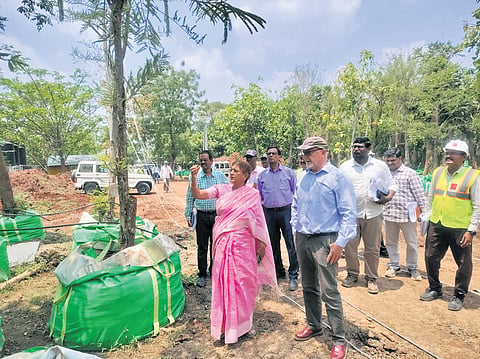

VIJAYAWADA: The Amaravati Development Corporation (ADC) has highlighted its focus on eco-tourism as part of the capital city’s development plans. Chairperson and Managing Director D Lakshmi Parthasarathi briefed a visiting World Bank technical team on the ongoing projects aimed at integrating environmental sustainability with tourism potential.
During the tour, the team inspected the Gravity Canal, a 7.8 km stretch of which 5.9 km has already been completed. This canal channels excess floodwater from Kondaveeti Vagu into the Krishna River.
ADC explained that the canal is being developed with landscaping, avenue plantations, and boating facilities to create vibrant eco-tourism corridor.
The delegation also visited the Translocation Nursery at Ananthavaram, where large trees obstructing construction are relocated, preserved, and replanted across Amaravati. Medicinal plants are also maintained, and the nursery is expected to serve as a green lung space for residents and employees in the region.
At Neerukonda, ADC is constructing a reservoir across 440 acres with a capacity of 0.4 TMC. About 30% of the work is complete, and the project is expected to be ready by next March. Similarly, the Penumaka Reservoir, covering 190 acres and with a 0.1 TMC capacity, is being developed with tourism in mind. Finally, the team inspected the Kondaveeti Vagu flood pumping station at Undavalli, where officials explained floodwater management systems.
World Bank, ADB teams visit Amaravati project sites
The joint mission teams from the World Bank (WB) and Asian Development Bank (ADB) continued their second day of inspection in Amaravati, reviewing the progress of capital city development projects under the AP Capital Region Development Authority (APCRDA).
The delegation began by visiting construction sites managed by RVR and NCC companies, where they assessed environmental and social management practices (ESMU) and worker facilities. Flood management projects across the capital region were also inspected, with APCRDA and ADCL officials briefing the delegation on ongoing progress.
Later, the teams toured villages in the capital area to observe skill development programs for women and youth, as well as social welfare initiatives. Discussions were held with APCRDA facilitators on the impact of these programs at the grassroots level.
At the APCRDA headquarters in Rayapudi, sessions were conducted on urban planning, transport infrastructure, and governance. Authorities highlighted that women trained under APCRDA initiatives are running these stalls, creating sustainable livelihoods.
