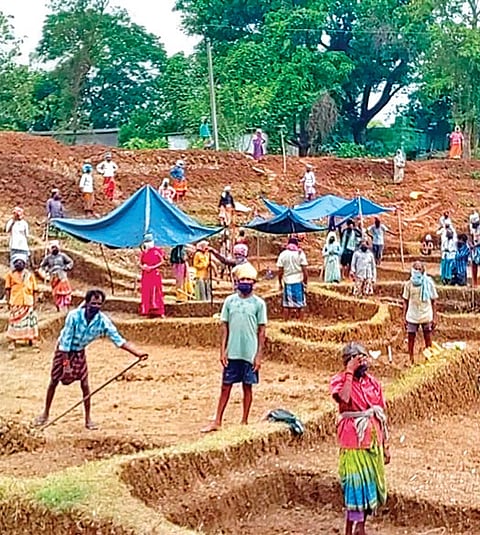

VISAKHAPATNAM: Andhra Pradesh recorded a 23.2 per cent decline in total person-days under the Mahatma Gandhi National Rural Employment Guarantee Act (MGNREGA), dropping from 2,422.84 lakh in 2024-25 to 1,859.77 lakh in 2025-26.
According to a report released by LibTech India, The report titled, ‘MGNREGA Tracker for Andhra Pradesh (FY 2025-26),’ highlights a broader contraction in employment generation across the State during the period, with key indicators showing a consistent decline compared to the previous financial year. The downturn began before the reported repeal of MGNREGA in December 2025 and intensified during the transition to the Viksit Bharat-Guarantee for Rozgar and Ajeevika Mission (Gramin) (VB-GRAMG) framework. The findings indicate that 2025-26 has been the weakest year for MGNREGA performance in Andhra Pradesh since bifurcation. Alongside the drop in person-days, registered households declined by 6.1 per cent, households that received work fell by 8.6 per cent, and the number of workers employed decreased by 10.1 per cent. The average number of workdays per household also declined by 16 per cent.
Access to sustained employment reduced significantly, with the number of households completing 100 days of work falling by 57.6.per cent. District-wise data shows that all 26 districts reported a decline in person-days, with the steepest reductions in NTR district (-46.5 per cent), Chittoor (-38.5 per cent) and Annamayya (-30.9 per cent).
Quarter-wise trends show that employment fell throughout the year. The October-December period recorded the highest proportional decline at 59.9 per cent, while the January-March quarter saw the largest absolute drop of around 170 lakh person-days. The report notes that the final quarter coincided with the post-repeal transition phase, which may have contributed to the sharper decline.
Despite an increase in the notified wage rate from Rs 300 to Rs 307 per day, overall earnings declined due to reduced availability of work. The average annual income per household fell from Rs 13,190 to Rs 11,616, a decrease of Rs 1,574. The report estimates that households could have earned around Rs 2,200 more if previous year employment levels had been maintained. Total wage expenditure also fell by Rs 1,210 crore.
The report points to a shrinking workforce, with a net loss of 4.58 lakh job cards and 12.33 lakh workers. It contrasts this with national trends, where workforce additions exceeded deletions.
Scheduled Caste and Scheduled Tribe households accounted for a significant share of income loss, estimated at Rs 484 crore, or about 40 per cent of the total decline.
LibTech India noted that the contraction is visible across the State and attributed it to reduced work availability as well as a decline in the workforce. It also flagged concerns over disruptions during the transition to the new framework.
The tracker provides an overview of employment trends, participation and income outcomes under MGNREGA, and is used by researchers and policy-makers to assess the implementation of rural employment programmes.
