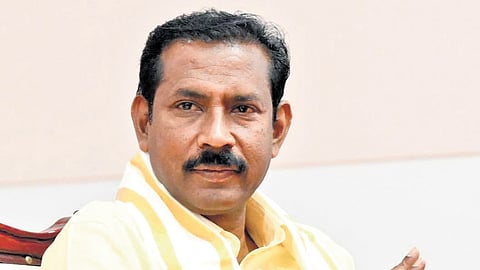

Congratulations on behalf of TNIE for being appointed as State TDP President for the second time. Are you happy about your continuation, or do you have aspirations for a Cabinet berth in the coalition government?
I am very happy that I have been given the responsibility of State President for the second term. It is a rare honor, and I never even imagined that I would become President once, let alone for a second term. I express my gratitude to our party president N. Chandrababu Naidu, Working President Nara Lokesh, senior leaders, and all our party workers who have supported me. Regarding a ministerial post, I have clearly stated earlier that I do not see it as a loss. For me, the role of State President is bigger than a ministerial position. A minister generally works within a department or a district, but as State President, I work with nearly one crore party members. That responsibility itself is much larger in my view. I have no disappointment about not being in the Cabinet.
What are your primary objectives for this term?
Ans: Our primary objective is to strengthen the party in a structured and disciplined manner. A political party cannot function only through elections or positions; it must be driven by ideology and committed cadre. That is the direction we are focusing on. We are working on building a strong ideological base among party workers. So far, we have trained around 5,000 cadre members. This training includes understanding governance, economic conditions, welfare programmes, and future challenges the state may face. The aim is to prepare them not just as workers, but as responsible political participants. We want party workers to be guided by commitment and ideology rather than personal gain, positions, or financial expectations. Only when the cadre is strong and ideologically rooted can the party serve society effectively and move forward in a balanced way.
How do you see the recent formulation of the TDP State and Central Committees, particularly the elevation of Lokesh as the party's national working president?
A: We have constituted the recent central and state committees based on social engineering by providing equal opportunity to all classes. We have appointed the committee members, who were disciplined and committed to the party, after detailed observation from the past decade and the database. Chief Minister and the national president have been working for the development of the state round the clock by attracting investments. He is taking care of the government and the development of the state. Therefore, our young leader has taken full responsibility for party strengthening by taking charge as the party's working president. He was well-connected with the party cadre in his Yuvagalam Padayatra. Therefore, we are happy to work under the leadership of Nara Lokesh in strengthening the party.
Of 185 members in the new TDP State Committee, 122 are from weaker sections including 77 from BCs. Beyond numbers, what role will they have in decision-making?
TDP is founded by beloved leader NTR for uplifting the BC, SC, and ST communities politically and financially. He gave immense opportunities to the underprivileged sections. We always give top priority to all the members in the committee. All of them have freedom in giving suggestions, express their opinions and in decision making for the betterment of the society as well as strengthening the party.
What challenges does TDP anticipate ahead and what is the strategy for the 2029 elections?
Our primary challenge for 2029 elections is to assure the investors as the previous YSRCP government has stalled all the developmental projects in their regime. Several companies including Frankin Templeton, Jockey, and Lulu were gone back due to the harassment of the previous government. Therefore, TDP led NDA coalition government came into power in 2029 elections again is dire need for the state. Another biggest challenge is to face the bad propaganda by the YSRCP through their media as well as social media.
Which BC Declaration promises have been fulfilled, and what is the timeline for the rest?
The BC Declaration is not something that exists only as a political agenda. It comes from public expectations and demands. Whenever there is a clear demand from the people, we respond to it and take necessary action. At present, we are focusing on ensuring proper implementation of reservation policies, particularly the 34 per cent reservation for BC communities. We do not see this as something that requires urgency in terms of announcements, but rather as a continuous process of implementation. As and when further demands arise, they will be addressed within the tenure of the government.
When will the government come up with the promised Protection Act for Backward Classes?
The BC Protection Act is part of our election promise. At present, there is no strong or widespread public pressure demanding it immediately. However, that does not mean it will be ignored. Some leaders are raising this issue, and we are aware of it. We have already stated that the Act will be brought within our tenure. It will be prepared and implemented in due course, as part of our commitment to BC welfare. Our approach is to ensure that promises made to the people are fulfilled systematically and practically, without unnecessary delay, but also considering the administrative process required.
What is your and the party’s stand on the BC Census?
The idea of a BC or caste census is linked to social justice. The purpose is to understand the actual population structure so that representation can be ensured in a fair and balanced manner. Our party’s ideology has always been rooted in social justice. We believe that political representation should show social realities. Only when we have accurate data can we plan and implement welfare and representation policies properly. This is not just a political issue, but a matter of ensuring that all sections of society receive their rightful place in governance and decision-making.
With TDP, Janasena and BJP in alliance, how will you ensure grassroots coordination and prevent conflicts among cadres?
There are some issues arising between TDP, JSP and BJP at the grassroots level. The main reason for these issues is the political dominance of the local leaders over others. Therefore, we have several coordination committees to resolve those issues in a timely in all levels. The coalition party leaders are also well aware of the attitude of YS Jagan, as the state's development would stall if he came into power again.
Indiscipline within the party came to the fore on several occasions despite the party supremo and N Chandrababu Naidu issuing a series of warnings. Particularly, the rift between Vijayawada MP Kesineni Sivanth and Tiruvuru MLA Kolikapudi Srinivasa Rao refuses to die down. What kind of action will be taken to curb such incidents?
I have already addressed this issue on multiple occasions. I have made it clear that someone must take a step back for a resolution to be reached in such situations. Otherwise, it leads to avoidable confusion among the public and affects the party’s image. I have been consistently advising all leaders that the party must function with ideological clarity and discipline. Leadership comes with responsibility and patience. When these are understood and followed, such differences do not arise. We have also clearly instructed everyone that internal matters should not be taken to the public domain or turned into street-level disputes. The party should not be exposed in a manner that creates unnecessary controversy or weakens public confidence. There may be differing perceptions in individual cases, and the party does not rush to conclusions on who is right or wrong in public. However, the organisation is closely observing all developments. At the appropriate time, necessary corrective action will be taken against those found responsible, in the interest of discipline and the party’s larger objective.
TDP leaders and activists are still attending court hearings for cases filed during the YSRCP government’s tenure. What measures are you taking to withdraw these cases and ensure their welfare?
At least 20,000 TDP family members have faced illegal cases during the previous YSRCP government. In the majority of cases, especially politically motivated cases, the police station stage is simply filing an FIR. Some cases were in the charge sheeted stage, and some were in sub judice. We have been trying to withdraw the politically motivated cases that are in the police station. The remaining cases that are in the court's purview will be cleared as per the court's directions. We, the party, always stand for the cadre especially faced with illegal cases during the YSRCP regime by providing medical, legal and educational help to them as well as their family members.
Was the Visakhapatnam Steel Plant issue settled? Though the Centre and State governments are assuring to safeguard the Steel Plant, there is still anxiety among the staff and workers. What initiative needs to be taken to pacify them?
We are committed to the safeguarding of the Visakhapatnam Steel Plant. We have successfully got Rs 15,000 crore financial revival package from the Union government to address severe working capital shortages, debt repayment, and operational distress in the Vizag steel plant. Now, both the management and the workers must take responsibility for improving production and ensuring that the plant operates at full capacity. We are sanctioning public money as the revival package. Therefore, the management as well as the workers should be accountable for the invested money. Otherwise, nobody can safeguard our steel plant unless the management and workers take responsibility for operating the plant at a profit.
There seems to be some delay in commencing the operations of the Visakhapatnam Railway Zone. What are the reasons?
There are some procedural delays in the commencement of the Visakhapatnam railway zone. We have allotted the land, and the gazette notification was also released. They are preparing the ground to call for the tenders. We are fast-tracking the commencement of the railway zone operations. The zone will commence no doubt about it, very shortly.
How do you plan to provide a permanent solution to pollution in the industrial hub of Gajuwaka?
Pollution is one of the biggest challenges we are facing, especially at Gangavaram Port. The port handles a large amount of bulk cargo, particularly coking coal, which is supplied to the steel plant, along with other bulk materials. To address this issue, we are constantly putting pressure on Gangavaram Port to ensure that the bulk cargo being imported or exported is kept under covered sheds. Although this is a costly measure, it can help control pollution to some extent. We are also requesting the creation of a green cover of 50 to 100 meters along the residential border of the port area, as well as regular sprinkling of water to reduce dust. Similar problems exist at Visakhapatnam Port, since port cities generally face pollution challenges unless cargo is containerised. However, container cargo is not economically viable, as importing and exporting containers is costly.
The TDP-led NDA coalition government focused on the development of Visakhapatnam with the most prestigious projects like the Google data centre. There are some objections being raised by the farmers, who gave their land to the projects. How do you sort out the issues?
There is a lot of misinformation being spread regarding development projects in Visakhapatnam. The arrival of global companies like Google is a major development. It shows confidence in the city and will lead to further investment and job creation. At the same time, concerns have been raised, particularly regarding land issues affecting farmers. We want to make it clear that no farmer will be put to loss. The government will ensure proper rehabilitation and compensation wherever required. In fact, those who are identified as occupiers under existing provisions will be provided with residential plots as part of the rehabilitation process. All concerns will be addressed in a fair manner while ensuring development continues.
You have already announced that the party will organise Mahanadu in an unprecedented scale this year. What is the significance, and what kind of reforms could the party cadre expect from the forthcoming Mahanadu? Why have you chosen the North Andhra districts, Srikakulam / Vizianagaram, this time?
Mahanadu is a platform where we revisit and reaffirm our core principles. The foundation laid by our founder, N. T. Rama Rao continues to guide us. His philosophy was simple: every person must have food, clothing, and shelter. Over time, we have adapted these principles to current conditions without changing their essence. At Mahanadu, we discuss and refine our approach based on present-day needs. We have chosen North Andhra districts such as Srikakulam and Vizianagaram, randomly to strengthen the organisation in those regions. The focus remains on strengthening the party cadre, because without strong workers, the party ideology cannot reach the people.
Will your party working president Nara Lokesh have chance to become chief minister in this tenure if there is need of Chandrababu Naidu in central politics to get more financial assistance to the state of Andhra Pradesh?
He (Nara Lokesh) is not focused on becoming Chief Minister. His sole objective is to strengthen the party. All the reforms being implemented now are initiatives he introduced. With Chandrababu Naidu, we have the benefit of experienced senior leadership, and complementing that, significant transformative changes are being ushered in by young leader Lokesh. He harbours no intention of seizing everything (Power) for himself. He often reiterates, "The party is permanent; political power is transient. The party is our own home; political power is merely a rented house." Therefore, he advocates building up the party. His focus lies primarily on the party cadre rather than on the pursuit of political power. At the same time, there is a dire need for Chandrababu Naidu's leadership for the development of the state now. We will develop the state and become victorious in the 2029 elections with the support of Janasena president Pawan Kalyan and the blessings of the BJP.
