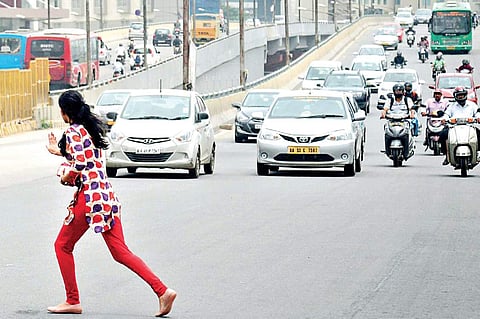

VIJAYAWADA: Andhra Pradesh continues to witness a worrying rise in pedestrian fatalities, raising fresh concerns over road safety and the protection of vulnerable road users, despite significant expansion of road infrastructure and one of the country’s largest National Highway networks.
According to the data shared by the Union Ministry of Road Transport and Highways (MoRTH) in the Lok Sabha, it is revealed that total pedestrian road fatalities in Andhra Pradesh increased from 579 to 838, making an increase of more than 40 percent over four years.
Similarly, the total road accident deaths have also reported an increase from 7,039 in 2020 to 8,346 in 2024, marking an increase of more than 18.5 per cent over the past four years.
The numbers rose to 8,186 in 2021, 8,293 in 2022, dipped marginally to 8,137 in 2023, and climbed again in 2024, indicating that pedestrian safety remains a persistent challenge.
The figures were tabled by the Ministry in the Lok Sabha in response to a question raised by Members of Parliament Manish Tewari and Sajda Ahmed.
Uttar Pradesh reported the highest number of road fatalities at 24,118, followed by Tamil Nadu (18,449), Maharashtra (15,715) and Madhya Pradesh (14,791). Andhra Pradesh ranked eighth in the country.
Ironically, the State has one of India’s most extensive highway networks, possessing the fourth-largest National Highway network, spanning 8,704 km, behind Maharashtra (18,462 km), Uttar Pradesh (12,314 km) and Rajasthan (10,733 km).
Road safety experts have repeatedly stressed that reducing pedestrian fatalities requires a combination of engineering improvements, stricter enforcement of speed limits, traffic calming measures in urban areas, better street lighting, clearly marked zebra crossings, public awareness campaigns and effective enforcement against dangerous driving.
India continues to account for one of the world’s highest numbers of road crash fatalities, with pedestrians among the most vulnerable road users, underscoring the urgent need for sustained investment in safer road design alongside expanding transport infrastructure.
Road safety experts note that while improved highways enhance connectivity and economic growth, higher traffic speeds, inadequate pedestrian crossings, urban expansion and increasing vehicle density can significantly elevate risks for pedestrians if safety infrastructure does not keep pace.
The Ministry informed Parliament that pedestrian regulation falls partly under the powers of State governments under Section 138 of the Motor Vehicles Act, 1988., enabling them to regulate pedestrian access to public places and National Highways, prohibit vehicles from using footpaths and pavements, and frame rules to prevent danger to the public.
For National Highways, pedestrian facilities are developed in accordance with IRC:103-2022 - Guidelines for Pedestrian Facilities, issued by the Indian Roads Congress.
The guidelines mandate infrastructure such as footpaths, pedestrian crossings, foot overbridges and underpasses wherever required, based on traffic studies and site assessments.
Safety audits are also carried out during the design, construction and pre-opening stages, as well as on existing highways, to identify and address safety deficiencies.
The ministry clarified that under Rule 166 of the Central Motor Vehicles Rules, 1989, the design, construction and maintenance of roads other than National Highways should conform to Indian Roads Congress standards or guidelines issued by State governments.
