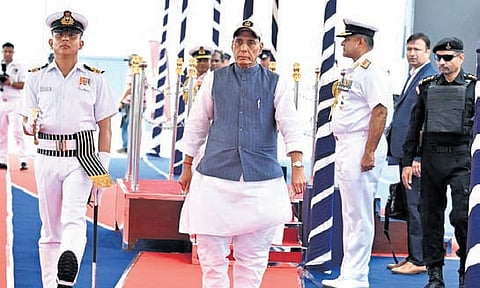

VISAKHAPATNAM: The Indian Navy commissioned the indigenously built stealth frigate INS Mahendragiri into its Eastern Fleet in Visakhapatnam on Saturday, marking the induction of the sixth of the seven Project 17A Nilgiri-class stealth frigates.
At the commissioning ceremony, Defence Minister Rajnath Singh underscored India’s progress in indigenous defence production and described Andhra Pradesh as an emerging centre for defence and aerospace manufacturing.
“Andhra Pradesh has emerged as a new powerhouse of India’s defence and aerospace manufacturing. It is playing its role across air, water, land, and the unmanned domain,” he remarked, adding, “This means the weapon systems that we once used to import from abroad will now be produced near our own Vizag,” he said.
He cited the foundation stone laying for the Advanced Medium Combat Aircraft (AMCA) Core Integration and Flight Testing Centre at Puttaparthi and Bharat Dynamics Limited’s upcoming Naval Systems Manufacturing Facility in Anakapalli, where autonomous underwater vehicles, torpedoes and underwater countermeasure systems will be produced.
“AMCA in the skies, BDL’s naval systems in the depths of the ocean, Kurnool’s drones in the unmanned domain, and today, INS Mahendragiri on the surface of the sea signify that Andhra Pradesh is now contributing to India’s defence strength across every sphere,” he noted.
The Defence Minister also underlined the changing character of warfare, observing that technological advances were transforming military operations without diminishing the importance of conventional capabilities.
“Future wars may be fought with Artificial Intelligence, but they will still be won by national resolve, trained soldiers and credible military power,” he remarked. Emerging technologies such as artificial intelligence, drones, cyber warfare, hypersonic weapons and space-based systems, he emphasised, complement rather than replace conventional military platforms.
Citing Operation Sindoor, the Defence Minister pointed to the operation as an illustration of the effective integration of modern technologies with conventional military capability.
The frigate was designed by the Indian Navy’s Warship Design Bureau and built by Mazagon Dock Shipbuilders Limited, Mumbai. With over 75% indigenous content, the 6,670-tonne warship can attain 28 knots. It is configured for fleet air defence, anti-surface and anti-submarine warfare, maritime interdiction, surveillance and HADR.
It carries supersonic and medium-range missiles, stealth features, sensors, network-centric systems, anti-submarine weapons and a multi-role helicopter. It could also be equipped with the BrahMos missile system.
Describing maritime security as integral to India’s economic interests, the Defence Minister observed that secure sea lanes were essential for trade, energy security and resilient supply chains. He noted that the Indian Navy’s humanitarian assistance, anti-piracy operations and evacuation missions had reinforced its role as a first responder and a preferred security partner in the Indo-Pacific.
Referring to Operation Urja Suraksha during the West Asia conflict, he stated that the Navy had safely escorted 18 merchant vessels carrying cargo worth more than Rs 9,000 crore.
Chief of the Naval Staff Admiral Krishna Swaminathan described INS Mahendragiri as another milestone in indigenous warship construction that would strengthen the Navy’s operational capability.
Built with contributions from more than 200 Indian industries, including several MSMEs, the frigate is named after the Mahendragiri mountain range in the Eastern Ghats and will enhance the Navy’s operational reach in the Indian Ocean Region.
