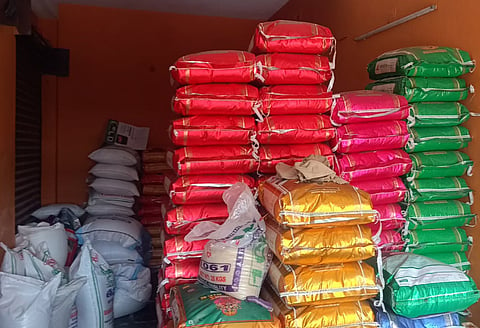

VIJAYAWADA: The sharp rise in rice prices has emerged as a major concern for common and middle-class families across the state, with the increasing cost of the staple food placing a heavy burden on household budgets.
The steady increase over the past few months has made it difficult for many households to manage their monthly expenses, prompting demands for the government to intervene and check the price rise.
Among essential commodities, the rice price hike is affecting a large number of families in the state.
A 26-kg bag of rice, which was sold between Rs 1,000 and Rs 1,300 during the Sankranti season in January, depending on the variety and brand, is now being sold between Rs 1,500 and Rs 1,800.
The increase of Rs 300 to Rs 500 per 26 kg bag is added to the household expenditure.
The widening gap between paddy procurement prices and retail rice prices has also come under scrutiny.
A 77-kg bag of paddy purchased from farmers for around Rs 1,000 to Rs 1,500 can yield about two 26-kg bags of rice in a modern mill, depending on the milling recovery and variety.
Each 26-kg bag is then sold in the retail market for Rs 1,500 to Rs 1,800.
The pricing pattern has fuelled allegations that rice millers are the biggest beneficiaries, leading to demands for greater transparency in pricing and stricter market monitoring.
Consumers claim that while farmers are not receiving remunerative prices for their crop, the burden of inflated prices is being passed on to rice consumers.
Farmers say they are not receiving remunerative prices despite months of cultivation and investment, while consumers are paying substantially higher prices for their staple food.
They also allege that inadequate monitoring by the Civil Supplies, Legal Metrology and Revenue departments has allowed arbitrary price hikes to continue unchecked, leading to growing public resentment and demands for immediate government intervention.
In Rythu Bazars, Sona Masoori and Samba Masoori varieties are being sold at around Rs 48 per kg, while 2716 and 1071 varieties are available at around Rs 44 per kg.
Although these are reportedly fine rice varieties, many consumers are reluctant to purchase them, saying the quality does not match their expectations.
‘’ Fine rice is being sold at Rythu Bazars for around Rs 47 to Rs 50 per kg.
However, many consumers continue to prefer purchasing branded rice from retail and wholesale outlets.
J. Sathish Kumar, a resident of Machilipatnam, said rice is now being sold at Rs 60 to Rs 65 per kg, making it difficult for families to cope with rising expenses.
“We are spending nearly Rs 2,000 a month on rice alone. The government should immediately intervene, hold discussions with rice millers and take steps to reduce prices,” he said.
Siddineni Bhaskar Rao, a retail grocery shop owner, said retailers are also facing criticism from customers over the continuous increase in rice prices. “Customers question us every day and express their frustration over the steep increase in prices.
We also feel unhappy about the situation, but it is beyond our control. The prices are fixed by the rice millers, and we have to sell at those rates,” he said.
The burden on households has increased further with the rise in the prices of other essential food items. Chicken is currently being sold at around Rs 300 per kg, while skinless chicken costs between Rs 330 and 350 per kg.
