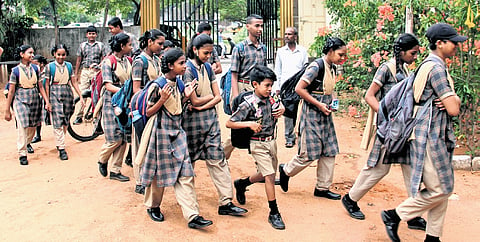

VIJAYAWADA: The Andhra Pradesh government will roll out the Thalliki Vandanam scheme on July 22, with financial assistance being credited directly into the Aadhaar-linked bank accounts of eligible mothers and guardians. The State has earmarked Rs 10,120.78 crore for the scheme during the current academic year, benefiting an estimated 67.47 lakh students.
Under the scheme, eligible mothers or guardians will receive Rs 15,000 per child annually, irrespective of the number of children studying from Classes I to XII, including Intermediate, in recognised government, aided, private unaided and residential schools and junior colleges.
However, Rs 2,000 per student will be deducted at source to strengthen the educational ecosystem. Consequently, Rs 13,000 will be transferred through the Direct Benefit Transfer (DBT) system into Aadhaar-seeded bank accounts, while the deducted amount will be utilised for school and junior college maintenance, sanitation, hygiene and infrastructure development.
In the first phase on July 22, assistance will be released to 64,76,590 verified students belonging to 41,07,502 mothers and guardians. The beneficiary count is expected to rise to 67,47,190 students and 42,70,802 mothers and guardians after the inclusion of fresh admissions to Class I and Junior Intermediate and correction of pending records.
The government expects around 59,500 new admissions to Class I, 56,100 admissions to Junior Intermediate, besides rectifying nearly 1.55 lakh invalid or incomplete records.
The scheme covers students enrolled in recognised government, aided, private unaided and residential institutions in Andhra Pradesh. However, students pursuing courses in ITI, Polytechnic, RGUKT (IIIT) and other institutions already covered under fee reimbursement schemes will not be eligible.
Existing eligibility norms have been retained. Monthly household income should not exceed `10,000 in rural areas and `12,000 in urban areas, and at least one family member must possess a rice card. Families owning more than three acres of wetland or ten acres of dry land, residential property exceeding 1,000 sq ft in municipal areas, or a non-exempt four-wheeler are ineligible.
Households with average monthly electricity consumption above 300 units, income-tax payers and most government employees have also been excluded, though sanitation workers, Anganwadi workers and certain low-income government employees have been exempted.
In single-parent families, the amount will be credited to the father’s account where applicable.
