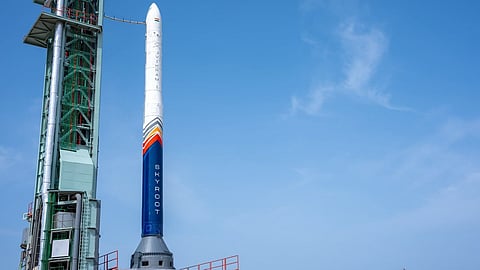

VISAKHAPATNAM: The successful launch of Vikram-1, India’s first privately developed orbital-class launch vehicle, has highlighted the role played by the Visakhapatnam Special Economic Zone (VSEZ) in supporting India’s emerging private space industry, with Skyroot Aerospace’s manufacturing facility operating from a Special Economic Zone under its administrative jurisdiction.
Skyroot Aerospace set up its manufacturing unit in 2021 at the GMR Aerospace and Industrial Park Special Economic Zone in Hyderabad, which comes under the administrative jurisdiction of VSEZ.
Vikram-1 was successfully launched on Saturday from the Satish Dhawan Space Centre (SDSC-SHAR) in Sriharikota under Mission Aagaman. All four stages performed as planned and the onboard payloads were deployed into orbit.
Developed to carry payloads of up to 350 kg to Low Earth Orbit, the rocket features an all-carbon composite structure and in-house propulsion systems, including 3D-printed engines and high-thrust solid boosters.
The maiden flight carried technology demonstration payloads from Grahaa Space, Cosmoserve, DCubed and Skyroot’s own SCOPE experiment.
In a statement, VSEZ said the success of Vikram-1 demonstrated the capability of the Special Economic Zone ecosystem in supporting globally competitive, technology-driven manufacturing through enabling infrastructure and a conducive policy environment.
It added that the achievement underscored the growing role of SEZs in attracting investments in aerospace, defence, electronics and advanced manufacturing while contributing to the country’s efforts to strengthen indigenous manufacturing and innovation.
Chief Minister N Chandrababu Naidu said the successful maiden orbital flight marked another historic milestone for India and demonstrated that the country’s private space sector was ready to stand alongside the world’s best.
In a post on X, he stated the achievement reflected the coming together of India’s scientific institutions and entrepreneurial talent to push the frontiers of innovation.
Deputy Chief Minister K Pawan Kalyan said the success of Mission Aagaman marked the beginning of a new phase of innovation and enterprise in India’s space sector. He added that the achievement reflected the impact of reforms that opened the space sector to private participation and would create fresh opportunities in scientific research, technology, manufacturing, start-ups and high-skilled employment, while strengthening India’s position as a global innovation hub.
HRD Minister Nara Lokesh, who witnessed the launch at Sriharikota along with his son, described the mission as a defining milestone for India’s private space ecosystem.
Congratulating Skyroot Aerospace, ISRO, IN-SPACe, NSIL and everyone associated with the mission, he stated the successful first attempt would encourage more young Indians to pursue innovation and contribute to the country’s expanding space programme.
