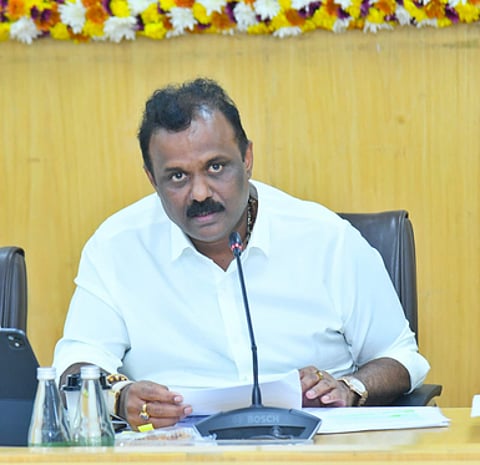

VIJAYAWADA: In a major step towards modernising property registration services, the Andhra Pradesh Government has decided to establish Registration Seva Kendras (RSKs) under a Public-Private Partnership (PPP) model, introducing a technology-driven single-window system aimed at making registrations faster, more transparent and citizen-friendly.
Inspired by the Passport Seva Kendra model, the initiative seeks to reshape the delivery of registration services through digital technology, improved infrastructure, and streamlined procedures while retaining statutory powers with the government.
Revenue Minister Anagani Satya Prasad recently issued GO 396 approving the establishment of 26 Registration Seva Kendras, one in each district headquarters except Polavaram and Alluri Sitarama Raju districts. The proposed centres will function as Sub-Registrar Offices, offering services such as Anywhere Registration, advance slot booking, integrated online payments, Public Data Entry and time-bound delivery of registered documents through a single-window system.
Notably, the Registration and Stamps Department is one of the busiest public-facing departments, handling a large volume of property transactions every year. Although several services have already been digitised, citizens often continue to face delays, multiple visits to registration offices and dependence on intermediaries. The RSK initiative has been designed to address these challenges by creating model registration centres equipped with modern infrastructure, digital workflow and citizen-friendly facilities.
The new system will enable citizens to book appointments in advance, make integrated online payments and submit document details electronically before registration through the Public Data Entry system.
All statutory powers to remain with Revenue Dept
These features are expected to reduce waiting time, minimise clerical errors, improve efficiency and ensure greater transparency in the registration process.
Under the PPP model, the selected private partner will invest in infrastructure, technology, manpower, operations and maintenance while functioning under the supervision of the Registration and Stamps Department. The partner will be permitted to collect a facilitation charge of up to Rs 2,000 per document, while all statutory powers relating to document registration, approval and maintenance of official records will continue to remain exclusively with the government.
The initiative is expected to significantly enhance the quality of registration services while providing citizens with a faster, more convenient and technology-enabled experience.
“The objective is to improve transparency, reduce waiting time and provide better facilities to citizens. The project will be initially implemented in the 26 district headquarters, and after reviewing its performance, may be expanded further,” BR Ambedkar, Inspector General of Registration and Stamps, told TNIE. Only facilitation, infrastructure and support services will be handled under the PPP model, while all statutory powers of registration will continue to remain with government authorities.
The tender process is being overseen by Andhra Pradesh Technology Services (APTS), and is expected to be completed within two months. It should be noted that, the State currently has 296 Sub-Registrar Offices, if the proposed RSK model is successful, the government is likely to establish RSKs in all those areas.
Meanwhile, the proposal has generated discussion among consumers and associated persons like document writers, DTP and internet centre operators, stamp vendors, deed assistants and helpers who have been providing services for decades, claiming the new system could threaten the livelihood of nearly one lakh families dependent on registration-related work.
“The government has every right to improve public services, but it should not eliminate an entire ecosystem in the process. Preparation of documents has always been the citizen’s choice. It should not become a government-mandated service under a single-window mechanism,” said Chintakayala Naga Satyanarayana Murthy, president of the Document Writers Welfare Association, Vijayawada.
The association will go on a pen-down strike from July 20 to 31, demanding that the government retain a parallel system instead of making the proposed single-window model the only mode of document facilitation, he said.
YSRCP deplores privatisation
The YSRCP charged that the move to privatise the Registration Department constitutes a direct assault on public assets, and warns that it plays with the security of citizens’ lands.
The YSRCP claimed that handing over sub-registrar services to private entities is a dangerous conspiracy to place public property and highly confidential personal data—including land ownership records, encumbrance certificates (EC), stamp duty collections, and court cases—into private hands across 294 sub-registrar offices.
It was alleged that this PPP model replaces strict government control with private operators, effectively opening the floodgates for the land mafia and illegal real estate syndicates to orchestrate land-grabbing schemes targeting ordinary citizens and farmers.
The shift to private registration centres is projected to drive government employees out of their roles, and destroy the livelihoods of countless local document writers who have traditionally depended on the sub-registrar ecosystem for generations.
The opposition argued that the previous administration utilised advanced drone, GPS and QR-coded digital systems, whereas the current government has contributed nothing new
AP govt strongly defends PPP model
The State government strongly clarified that institutional and statutory control over registration functions remains firmly and legally vested with the Registration Department; private partners will strictly handle only administrative paperwork, technology maintenance, and infrastructure support.
The government explained that the establishment of Registration Seva Kendras (RSKs) across district centres—modelled after the successful Passport Seva Kendras and existing frameworks in Maharashtra—is an administrative reform designed to provide hassle-free, time-bound, and transparent single-window services.
While citizens currently spend anywhere between Rs 5,000 and Rs 10,000 on private documentation and paperwork before registration, the institutionalised RSKs will formalise the pre-registration process and offer these streamlined services for a maximum capped facilitation charge of just Rs 2,000.
By standardising the documentation process within government-regulated service centres, the new policy aims to eradicate the deeply entrenched system of unauthorised middlemen, enhance transparency, minimise corruption, and ensure data security without transferring records to private custody
