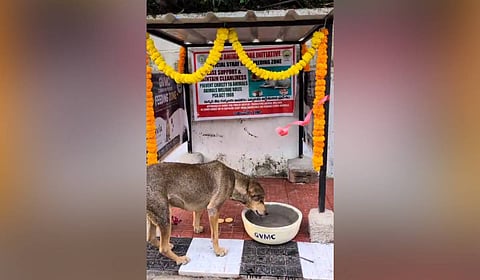

VISAKHAPATNAM: In a first for Visakhapatnam, the Greater Visakhapatnam Municipal Corporation (GVMC), in collaboration with the Mahvia Foundation, has introduced designated feeding zones for stray dogs to promote organised feeding and discourage indiscriminate feeding in public places.
Two feeding zones have been introduced on a pilot basis, while around 98 locations have already been identified across the city for the initiative.
The pilot feeding zones have been set up behind the Port Hospital area and in the IT SEZ area. The locations were chosen as they have relatively low public movement and are away from hospitals, schools and other sensitive areas to avoid inconvenience to residents.
Speaking to the TNIE, GVMC City Veterinary Officer Dr Kiran Kumar said the initiative was introduced following instructions from the Municipal Commissioner after the civic body observed that stray dogs were being fed at random locations across the city.
While the Veterinary Department has been conducting animal birth control camps and operating shelters to manage the stray dog population, indiscriminate feeding was leading to sanitation issues and littering in public places.
“People feed dogs with good intentions, but food is often left on paper or other disposable material and is not cleared afterwards. This results in littering and dogs gathering at different places.
We wanted to introduce a proper system where people can feed stray dogs at designated locations,” he said.
Each feeding zone has a small roofed structure with feeding and water bowls to ensure food and drinking water remain protected even during rain.
Dr Kiran Kumar said GVMC had earlier identified feeding points using banners, but the effort did not achieve the desired results as some of the banners were removed.
The present model has therefore been introduced on a pilot basis. The 98 locations were identified this month through a ward-wise exercise.
Dr Kiran Kumar said the civic body plans to establish at least one feeding zone in each ward.
In areas where one feeding zone may not be sufficient because stray dogs move across different localities, additional locations will be identified.
The project has been taken up in coordination with the Mahvia Foundation following discussions involving the Veterinary Department, the Public Health Department and the Chief Medical Officer.
