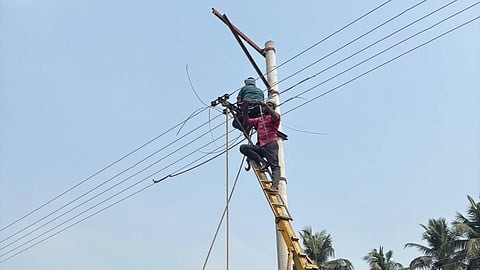

VIJAYAWADA: Power distribution utilities in Andhra Pradesh are aggressively advancing agricultural feeder segregation under the Revamped Distribution Sector Scheme (RDSS) to ensure a guaranteed, continuous nine-hour daytime electricity supply to the farm sector while significantly improving overall rural power quality.
The statewide initiative aims to decouple agricultural loads from general rural distribution networks wherever farming loads exceed 30 per cent, thereby stabilising grid performance, and extending round-the-clock three-phase electricity to non-agricultural rural consumers.
Highlighting the progress in the eastern coastal belt, APEPDCL Chairman and Managing Director Prudhvitej Immadi stated that 721 agricultural feeders out of 994 identified for segregation have already been decoupled across the Discom’s operational domain.
The CMD noted that this milestone has directly enabled 1,383 villages to get uninterrupted 24x7 three-phase power supply for domestic, commercial, and healthcare needs.
SPDCL segregates 1,934 farm feeders, CPDCL 638
Simultaneously, infrastructure works are advancing across the State’s other distribution utilities, with APSPDCL in the southern region identifying 3,480 feeders and segregating 1,934 so far, while APCPDCL in the central belt has identified 1,106 feeders, and completed works on 638 feeders.
According to senior energy department officials, separating agricultural loads from general rural lines addresses a decades-old structural bottleneck in power management. Previously, in unsegregated networks, rural domestic electricity supply was directly linked to farm pump set circuits.
To manage total grid load and prevent systemic overloading, electricity to the agricultural sector had to be supplied intermittently across staggered day and night shifts rather than in a single, continuous daytime block.
This practice triggered severe distribution discrepancies, frequent network trippings, low-voltage problem, and recurring burnouts of distribution transformers across rural habitations.
Feeder segregation systematically resolves these operational issues by creating dedicated distribution circuits exclusively for agricultural pump sets. Crucially, power utilities are executing the simultaneous solarisation of these newly segregated feeders under ongoing renewable energy programmes.
Feeding decentralised solar power directly into segregated agricultural circuits delivers high-quality, high-voltage electricity during peak daytime irrigation hours.
Officials emphasised that this strategic integration significantly eases the financial and operational burden on Discoms by lowering expensive peak-hour thermal power procurement costs, and bringing greater transparency to the State agricultural power subsidy management. This statewide momentum aligns with decisions taken during the recent State Distribution Reforms Committee review meeting chaired by Chief Secretary G Sai Prasad.
Taking note of field-level execution challenges—such as GIS mapping adjustments, Right-of-Way constraints, and seasonal weather disruptions—the State government has officially extended execution contracts for ongoing feeder segregation works across all three Discoms through March 31, 2027.
The Chief Secretary directed officials to ensure that all remaining feeder separation and network modernisation projects are completed within the revised timeline to achieve full grid stabilisation.
