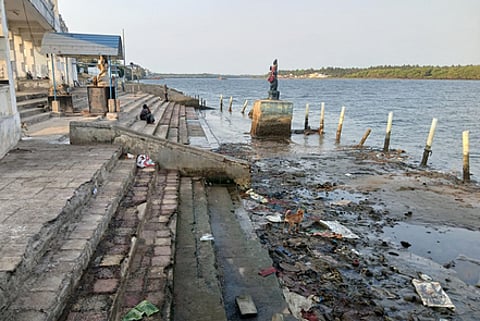

RAJAMAHENDRAVARAM: Concerns over the deteriorating water quality of the Godavari, a major tributary of the Vasista Godavari River in West Godavari district, have intensified following alarming findings on pollution levels and public health risks. The issue gained renewed attention after Deputy Chief Minister Pawan Kalyan expressed concern over contamination, warning that while people may seek spiritual merit through a holy dip, polluted waters could instead expose them to disease.
A study by YN College, Narasapuram, revealed several parameters exceeding permissible limits by wide margins. Turbidity was recorded at 16.8 mg/litre against the limit of 10 mg/litre. Total Dissolved Solids (TDS) reached 20,746 mg/litre, more than ten times the prescribed limit of 2,000 mg/litre. Water hardness was 4,402 mg/litre against the permissible 600 mg/litre.
Magnesium concentration stood at 937 mg/litre, nearly nine times the acceptable limit of 100 mg/litre, while chloride levels touched 7,206 mg/litre compared to the standard 1,000 mg/litre.
Iron content was 0.189 mg/litre against the safe limit of 0.05 mg/litre, while aluminium levels reached 0.623 mg/litre. Environmentalists and medical experts warned that the presence of disease-causing microorganisms, including E coli, further increases risks.
They attributed the growing pollution to untreated sewage discharge and indiscriminate dumping of solid waste along riverbanks. In Narasapuram town, about 9 MLD (million litres per day) of drinking water is supplied to residents. However, in the absence of a sewage treatment plant, nearly 3 MLD of wastewater is reportedly being discharged directly into the Vasista Godavari daily, raising serious concerns over public health, aquatic ecosystems and the future of one of the region’s most important waterways.
Speaking to TNIE, AP Pollution Control Board Executive Engineer A Seetharamachandra Murthy said the Board has recommended the construction of sewage treatment plants (STPs) in Palakollu, Narasapuram, Bhimavaram and Tanuku to curb pollution. He said it is the responsibility of the respective urban local bodies to take up the projects, which can receive financial assistance from the Central Government under schemes, including AMRUT.
Murthy added that current pollution levels in the Vasista River make the water unsuitable for direct drinking without treatment. He explained that the Gostani Drain carries agricultural runoff and joins the Yanamadurru Drain, which eventually flows into Upputeru before draining into the Bay of Bengal.
