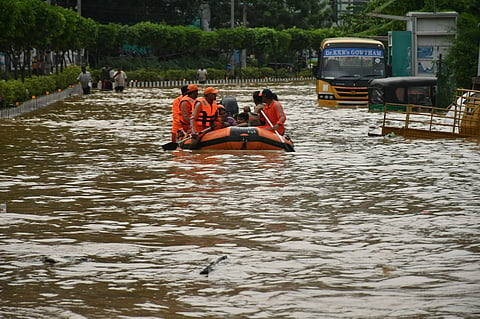

VISAKHAPATNAM: As many as 1.16 lakh people were internally displaced in Andhra Pradesh during 2025 due to cyclones and severe storm events, making the State one of the worst affected in the country, according to the State of India’s Environment 2026 report released by Down To Earth.
The report states that AP recorded 1,16,000 weather-related displacements, the highest among all States. Uttar Pradesh followed with 1,10,490 displacements, while West Bengal reported 80,000. Together, these States accounted for more than half of all displacements recorded across 28 States and Union Territories. The findings point to increasing vulnerability of AP to climate-related disasters.
AP records second-highest extreme weather days, says report
Extreme weather events affected the State on 58 days between October and December 2025, the second-highest in the country after Himachal Pradesh, which recorded 62 days.
The trend has continued into 2026. During the first three months of the year, AP recorded 10 days of extreme weather, compared with zero in 2022, three in 2023, two in 2024 and one in 2025 during the same period.
Heat stress is emerging as a major concern. In 2025, two weather stations in AP recorded their highest temperatures in 124 years of observations, while five stations registered record monthly temperatures. The report notes that the number of annual hot days has increased from 42 before the Paris Agreement period to 48 at the current global warming level of about 1.3°C. Even if global climate goals are achieved, annual hot days could rise to 73 by the end of the century.
Agriculture continues to face mounting pressure. AP, Maharashtra and Karnataka together account for nearly 70% of farm-sector suicides in the country. While suicides among farmers and cultivators in the State declined from 628 in 2019 to 88 in 2024, suicides among agricultural labourers rose from 401 to 692 during the same period. In 2023, the State recorded 201 farmer suicides and 724 suicides among agricultural labourers, indicating growing distress among rural wage workers.
The report also highlights concerns in the healthcare sector. The average expenditure per hospitalisation case in AP was Rs 4,982 in government hospitals, Rs 18,259 in charitable institutions and Rs 58,077 in private hospitals. Despite the cost difference, nearly 70% of patients sought treatment in private hospitals, while only 26.9% used government facilities. The State also recorded 2,049 suicides linked to illness.
Air pollution continues to impact public health. The report estimates that average life expectancy in AP is shortened by about two years and one month due to air pollution, while the estimated reduction in capital Amaravati is about two years.
Groundwater conditions remain largely stable, with 88.5% of assessed units classified as safe. However, 3.5% were categorised as semi-critical, 0.4% as critical and 1.8% as over-exploited.
On the environmental front, AP has 24 Automatic Weather Stations, three Doppler Weather Radars and five Agrometeorological Field Units covering 13 districts. Between 2015-16 and 2024-25, 1,803 hectares of forest land was diverted for non-forest purposes. Human-elephant conflict has also increased, with elephant-related deaths rising to 11 in 2024-25.
The report notes progress in urban waste management. Of the total 6,210 tonnes of waste generated daily, nearly 89% is processed, while 98% of the State’s 3,872 urban wards have achieved 100% source segregation. However, 15.11 lakh tonnes of legacy waste remains, with a significant portion yet to be treated and the affected land reclaimed. In the energy sector, fossil fuels accounted for 75% of electricity generation during 2025-26.
