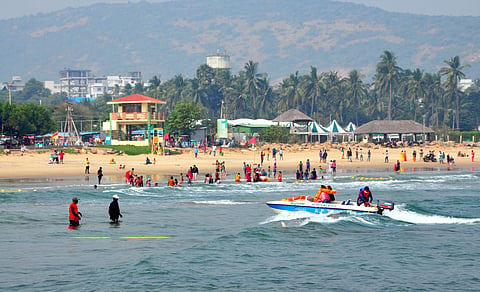

VISAKHAPTNAM: Aiming to strengthen beach safety through technology, the Space Applications Centre (SAC) of ISRO has partnered with Andhra University to develop an AI-enabled rip current detection and warning system under Project Bharati. The project seeks to provide real-time alerts to lifeguards, police and beach visitors, helping authorities respond more effectively to one of the leading causes of drowning incidents along the coast.
The two-year research project has been sanctioned by the Space Applications Centre (SAC), ISRO, Ahmedabad, at an estimated cost of Rs22 lakh. The study is being led by scientist Dr SVV Arun Kumar of SAC-ISRO and Prof CV Naidu, Head of the Department of Meteorology and Oceanography at Andhra University.
Rip currents are strong channels of water that flow away from the shore and can pull swimmers into deeper waters within seconds. They are considered one of the leading causes of drowning incidents at beaches across the world. Scientists say such currents are frequently observed along the Visakhapatnam coastline, particularly in areas where drainage channels and streams enter the sea.
As part of Project Bharati, researchers are developing specialised AI software capable of identifying where and when rip currents are likely to form. The system will analyse satellite data, weather conditions, oceanographic information and live video feeds to detect dangerous conditions before an accident occurs. Scientists involved in the project said nearly 60 per cent of the software development work has already been completed.
A key component of the initiative is the Next-Gen AI Lifeguard Alert System, a mobile beach safety unit designed to monitor coastal conditions around the clock. The unit will be equipped with AI-enabled 360-degree cameras capable of tracking beach activity and analysing wave patterns. Thermal cameras will allow monitoring during night-time and poor visibility conditions.
The system will also include a weather station to record wind speed, wind direction, temperature, humidity and atmospheric pressure, all of which influence sea conditions. Data collected from these sensors will be processed by an onboard AI system that continuously assesses risk levels along the beach.
Once a rip current is detected, the system will automatically classify areas as safe, caution or danger zones. Warning sirens, flashing emergency lights and public announcement systems will be activated to alert visitors. Safety messages and beach conditions will also be displayed on LED information boards. Lifeguards, Coastal Security Police and control rooms will simultaneously receive alerts through a 4G/5G communication network, enabling a faster response.
The mobile units will be powered by solar panels and mounted on movable platforms, allowing authorities to deploy them at different beaches based on seasonal conditions and safety requirements. Each unit is expected to cost around Rs 2 lakh.
Prof. Naidu note that rip currents can travel at speeds of up to five metres per second and may extend between 50 and 150 metres into the sea. “Because these currents are often difficult for the public to identify, an early warning system can play a critical role in preventing accidents. This is a pilot project. Once successful, it is likely to be launched across the nation,” he stated.
The project is expected to benefit agencies such as the Coastal Security Police, GVMC, the Tourism Department and beach management authorities.
Having studied rip currents along the Visakhapatnam coast since 2017, SAC scientists now aim to convert years of research into a practical safety tool that could eventually be deployed at beaches across India.
