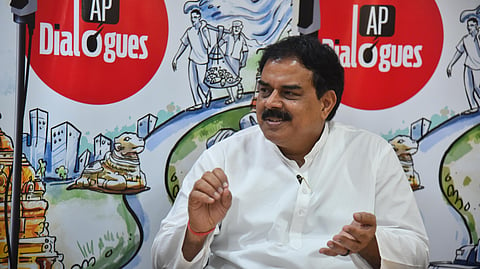

The Public Distribution System in AP is all set for a huge transformation under the dynamic leadership of Civil Supplies Minister Nadendla Manohar. As the government mulls making more commodities available at the ration shops in exchange for rice through digital currency, Minister Manohar shares his views on how the system will benefit ration card holders, the government’s plan to bring the Civil Supplies Corporation out of red and many more. Excerpts
Can the government improve the quality of ration rice and curb its diversion?
The Civil Supplies Corporation procures paddy, gets it milled and supplies rice through the Public Distribution System to nearly 40 lakh families. While 51 percent of the rice is covered under the National Food Security Act, the State bears the remaining burden. With the economic cost of rice at around Rs 46 per kg, ensuring quality and preventing misuse are key priorities.
We have already introduced fine rice varieties such as BPT and Sona Masuri on a pilot basis in the Mid-Day Meal Scheme. The response was excellent, with 98-99 per cent of students preferring school meals over food brought from home. Encouraged by this success, we are strengthening the PDS through technology-driven reforms. Mobile applications are being used to monitor fair price shops, with at least six shops inspected every month through an app-based system. Check posts have also been set up in vulnerable areas to prevent diversion. Better quality rice, technology and stronger monitoring will help build a more efficient and people-centric Civil Supplies system.
What is the plan behind offering cash instead of ration rice?
We are working on a concept. Earlier, in NTR district, we provided e-wallets to 5,000 beneficiaries under the Deepam scheme through Punjab National Bank. We are planning to introduce digital currency as an option of ration. The is expected to implement it in Visakhapatnam in our State. If the digital currency is introduced and an equivalent amount is credited to the consumer, the consumer can purchase commodities directly from the ration shop itself. We are currently trying out this model and others too.
What steps have been taken to control the middlemen system and protect the farmers?
The previous government strengthened the middlemen system and caused severe hardship to farmers. It deprived farmers of the freedom to sell their produce to buyers of their choice. The system was designed in favour of millers rather than farmers. Under the leadership of Chief Minister Chandrababu Naidu and Deputy Chief Minister Pawan Kalyan, we have introduced reforms and stood firmly by the farmers. We have carried out paddy procurement on a record scale. In 2023-24, the YSRCP government procured only 42.61 lakh MT of paddy in both Kharif and Rabi seasons. In 2025-26, we procured 73.75 lakh MT of paddy from 7.70 lakh farmers. We paid Rs 30,361 crore to the farmers, and the payments were made within hours.

The Opposition blames your department for rising edible oil and pulse prices. How do you respond?
The State government closely monitors the prices of 14 essential commodities through an empowered group of ministers and a Cabinet sub-committee. Whenever necessary, we intervene to protect consumers, and maintaining price stability remains a key priority. The recent rise in edible oil prices is largely due to global factors. India imports nearly 60 per cent of its edible oil requirement, with palm oil sourced mainly from Malaysia and Indonesia, and sunflower oil from Ukraine and Russia. Geopolitical developments, fluctuations in crude oil prices and higher transportation costs have all contributed to the increase. Whenever prices cross a certain threshold, the government steps in with market interventions. For instance, palm oil is supplied at subsidised rates through nearly 29,000 fair price shops across Andhra Pradesh. Similar measures were taken last year when prices surged. Despite global challenges, the State has managed to keep essential commodity prices under control through timely and proactive interventions.
Critics say Deepam-2 has excluded many poor families. Your response?
When Deepam was launched, we estimated that over one crore beneficiaries would be covered. After reconciling data with oil marketing companies, Andhra Pradesh became one of the first States to implement the scheme effectively. Every eligible beneficiary with e-KYC and a rice card can avail the benefit. Nearly 98 lakh people benefited in the first phase, and four phases have been completed so far, with the fifth underway. Around 4.24 crore LPG cylinders have been distributed, benefiting 93-94 lakh families in each phase. Reimbursements are credited within 72 hours. We have fulfilled our promise of providing three free cylinders annually and continue to bear the additional cost despite LPG prices rising from Rs 842 to around Rs 930-945 per cylinder.
Rice millers are exploiting GST rules. What action will be taken?
I noticed it too. Some traders are misusing GST provisions through packaging practices, and this needs attention, though there are legal limitations in dealing with 26-kg bags. Beyond enforcement, our focus is on promoting quality rice varieties that have strong market demand. Kurnool rice is a good example of successful branding. We have encouraged farmers to cultivate traditional and preferred varieties that are no longer widely grown. By linking production with consumer demand and promoting high-value varieties, we aim to create better market opportunities and improve returns for farmers.
How will the government support BPT and Sona Masuri farmers?
The Minimum Support Price (MSP) is fixed by the Central government based on a scientific formula. This has been the established practice for many years, and the State government has a limited role in the matter. If farmers are empowered and provided with greater awareness, they will come forward on their own. Selling their produce to the government is beneficial to them, as payments are credited within eight hours. This itself is a form of empowerment, and it also contributes to the growth of the local economy.
Has the Civil Supplies Corporation recovered from its financial crisis?
We inherited a severely distorted system and liabilities of Rs 28,434 crore, including high-interest borrowings raised by the previous government. Correcting those issues has been a major challenge. One example was the MDU van system, under which 9,260 vehicles created an annual burden of about Rs 760 crore through salaries and loan repayments. We discontinued the arrangement and, through prudent financial management, have restructured nearly Rs 28,434 cr over the past two years to improve efficiency and fiscal sustainability.
Has your soft image come at the cost of tough action?
Governance is not about appearing tough; it is about building accountable systems and delivering results. Under the leadership of the Chief Minister and Deputy Chief Minister, we are correcting distortions inherited from the previous government and strengthening responsibility at every level. While challenges and delays can arise between policy and implementation, we constantly review progress to ensure commitments are fulfilled. My focus is not on projecting an image but on effective governance. Public trust comes from timely execution, problem-solving and teamwork, and our effort is to strengthen the system through collective responsibility.
How will Jana Sena strengthen its grassroots organisation?
Jana Sena has emerged as a strong political force under Pawan Kalyan’s leadership, reflected in its 100 per cent strike rate. However, we recognise the need to further strengthen the organisation through organic growth. Leadership must emerge with the confidence of the cadre and public support, not merely through appointments. We are building a stronger organisational structure and will constitute committees in due course. As a party focused on youth and new-generation leadership, Jana Sena is nurturing capable young leaders who can take on greater responsibilities.