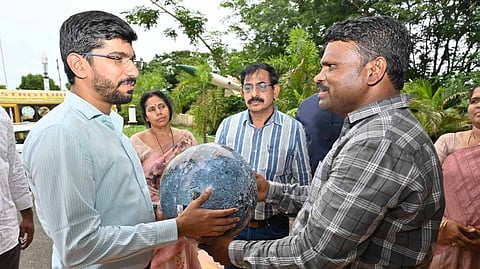

NELLORE: Born and raised in a remote tribal hamlet where schools functioned without proper classrooms, textbooks or laboratories, N Subrahmanyam grew up amid hardship and social discouragement, often hearing that children from his village and community were ‘not meant to study’. Those painful words, instead of weakening him, became the foundation of a lifelong resolve to prove that rural children are no less capable than their urban counterparts when given the right opportunities.
That resolve has guided Subrahmanyam’s three-decade journey in science education, bringing science beyond textbooks into the lives of rural children across Andhra Pradesh. Born into the marginalised Yanadi tribal community in Nellore district, his entry into science was shaped not by privilege but by hardship, curiosity and a desire to ensure no rural child felt helpless without books or guidance.
Growing up without laboratories or proper classrooms, he discovered science in leaves, under stones and in the night sky. Though his questions were many, answers were scarce, convincing him that rural children deserved hands-on, inquiry-based learning.
This conviction led him to teaching, not merely to deliver the syllabus but to ignite young minds. He began as a Secondary Grade Teacher at MPPUP School in Gumparlapadu and later served over two decades as a School Assistant in Biology at ZPHS Mahammadapuram in Podalakur mandal. Rejecting rote learning, he introduced low-cost models, field observation and nature-based learning.
He organised science fairs, guided students in research projects and recreated ancient Indian observatories to teach geometry and astronomy.
One of his most significant initiatives was Science on Wheels, later Space on Wheels. Recognising that most rural schools lacked laboratories, he converted a small vehicle into a mobile science lab with microscopes, telescopes and working models. Driving it himself, he conducted demonstrations, bringing STEM education directly to villages.
Workshops included microscope usage, sundial construction and night-sky observation. For many children, it was their first glimpse of the Moon and planets through a telescope. With support from Samagra Shiksha, his outreach evolved into a replicable rural education model. In 2018, he invested his own salary to establish the Rural Children Research Centre at Gandhijana Sangam in a tribal area of Sangam mandal. Conceived as a space for exploration rather than passive learning, the centre featured interactive exhibits, a butterfly garden, a weather station and a mini observatory.
His innovations included One Student, One Microscope, visual learning posters, biodiversity documentation and structured astronomy programmes teaching sky mapping and celestial navigation. In 2022, he was appointed Curator of the District Science Centre in Nellore at Chemudugunta.
There, he revitalised more than 56 exhibits, integrated them with digital resources and launched monthly workshops. Astrotourism initiatives enabled villagers and students to observe planetary movements and map lunar features. In 2023 alone, around 25,000 students and 50,000 members of the public participated in mobile exhibitions, astro camps and eco tours under his leadership.
Mentorship remained central to his philosophy. Through Inspire Awards, the State Science Congress and National Science Fairs, he guided 10 students to the national level and 30 to the state level. Their projects from solar water heaters to eco-friendly pest repellents and low-cost science models reflected his belief that innovation is universal and opportunity is link missing.
Between 2023 and 2025, his initiatives expanded further. Astrotourism programmes reached more than 50,000 participants. The Budding Scientists programme engaged around 100 students annually. The Cosmos Digital Learning Series was introduced for the 2025-26 academic year, constructivist classroom modules were implemented in schools.
“I come from a place where there were no classrooms, no laboratories, and often no answers to our questions. Science was not something I learned from books alone - it was something I discovered in the sky, in nature and through curiosity. My mission has always been simple: no rural or tribal child should ever feel that science is beyond their reach. Talent exists everywhere; opportunity must reach it,” N Subrahmanyam said.
