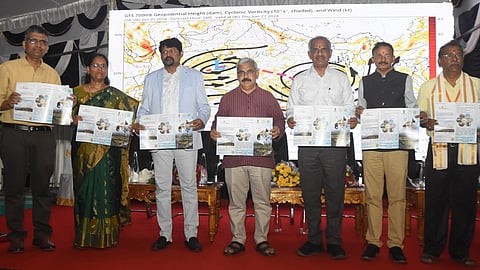

VISAKHAPATNAM: In a step aimed at improving weather monitoring and forecasting along the east coast, the Indian Institute of Tropical Meteorology (IITM) has set up a Coastal Atmospheric Research Testbed (C-ART) at Andhra University in Vizag. The open-field observatory was inaugurated by M Ravichandran, Secretary, Ministry of Earth Sciences, in the presence of Vice-Chancellor GP Rajasekhar and IITM Director A Suryachandra Rao on the university premises on Friday. It has been set up under Mission Mausam programme, which focuses on strengthening observational networks and improving weather prediction systems.
The testbed has been developed as an open-field observatory with advanced instruments to continuously monitor atmospheric conditions. Andhra University provided space for the facility to support long-term research collaboration.
The system combines instruments that record rainfall, wind, temperature, humidity and atmospheric processes. Disdrometers measure raindrop size and distribution, while weather stations track basic parameters. An eddy covariance tower studies exchanges of heat, moisture and gases between land and atmosphere. Scientists said the data will improve understanding of weather systems.
Data collected from the testbed is processed and fed into national weather models, helping improve the accuracy of forecasts. Additional instruments, including wind lidars and Doppler weather radars, are planned in the next phase. These will provide information on wind patterns, cloud structure and atmospheric composition, strengthening research capability of the facility.
Officials said the facility would support detailed studies of rainfall patterns, cloud formation and atmospheric interactions, and help improve early warning systems for cyclones and extreme weather events.
Ravichandran said improving observation systems is essential for better forecasting, especially in regions prone to severe weather. Vice-Chancellor Prof. GP Rajasekhar said it would boost research at the university.
IITM Director Suryachandra Rao noted that Visakhapatnam is a suitable location for such a facility due to its coastal setting and exposure to monsoon systems and cyclones. Speaking to TNIE, AU Meteorology and Oceanography Department Prof. P Suneetha said, “The testbed will generate high-resolution observations to address gaps in weather modelling, particularly in understanding cloud microphysics, rainfall variability and land-sea interactions. Despite cyclones in Bay of Bengal, their intensity varies along the coast. Studying such spatial differences, along with sea-level changes, will help improve regional climate assessment and forecasting accuracy.”
It is expected to serve as a national research platform, supporting scientific studies.
