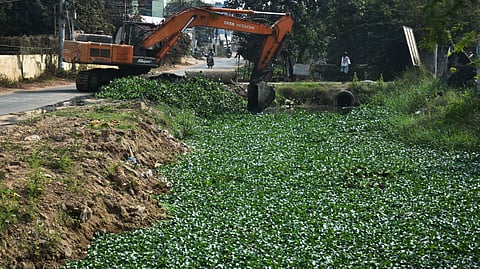

VIJAYAWADA: In a forward-looking step, the State gvernment of has unveiled a mission to rejuvenate water bodies while simultaneously creating sustainable livelihood opportunities for women.
In the recently issued government order, G.O.MS.No. 106, the Municipal Administration & Urban Development (MA&UD) Department, integrates water hyacinth clearance and resource recovery into the ongoing Jaladhara–Jalaharathi 100-Day Special Drive, running from April 6 to July 14, 2026.
The programme comes at a time when lakes, ponds, and canals across the state are under severe ecological stress due to unchecked water hyacinth growth.
The fast-spreading aquatic weed has been choking irrigation channels, degrading water quality, and threatening biodiversity.
Officials described the initiative as a mission-mode approach that goes beyond routine cleaning, combining environmental restoration with income generation. “This is not just a cleaning exercise. It is a long-term solution that combines ecological balance with livelihood creation,” a senior official said.
MA&UD will manage urban water bodies, Panchayat Raj & Rural Development (PR&RD) will oversee rural structures, and the Water Resources Department will clear irrigation canals and minor tanks. Unlike earlier efforts, the SOP addresses root causes by mandating strict prevention of untreated sewage inflow.
Localised Sewage Treatment Plants (STPs) and nature-based systems are being installed to ensure only treated water enters water bodies, reducing the recurrence of hyacinth.
Women’s Self-Help Groups (SHGs), mobilised by SERP and MEPMA, are receiving harvested biomass to process into organic compost, fibre products, and handicrafts.
Long stems are converted into commercial fibres, while leaves and roots are composted with cow dung slurry, maturing over 30 days into nutrient-rich manure.
Authorities expect the compost to reduce dependence on chemical fertilisers, lower input costs for farmers, and improve soil health. Surplus production meeting Fertiliser Control Order (FCO) standards will be aggregated and marketed through APMARKFED, ensuring steady income streams for women entrepreneurs.
Environmental benefits are expected to be equally significant. Cleaner water bodies will improve groundwater recharge, support aquatic biodiversity, and enhance urban landscapes. In rural areas, restored tanks and canals will strengthen irrigation and agricultural productivity.
District administrations are overseeing implementation with strong monitoring frameworks, including geo-tagged “before and after” documentation to ensure transparency.
Experts have welcomed the initiative as a model of integrated governance, noting that AP is setting a good example.
As the programme expands, neglected water bodies are expected to regain vitality, while women’s SHGs gain a sustainable foundation for economic progress. Officials said the mission reflects a broader policy direction.
