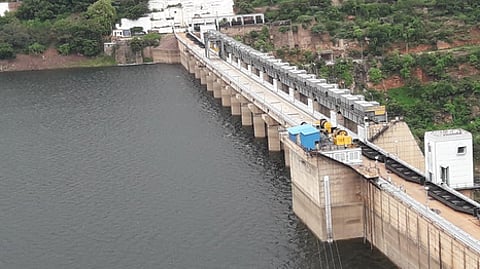

KURNOOL: Despite having adequate manpower, sophisticated machinery and well-maintained units, the Srisailam Right Bank Hydro-Electric Station (SRBHES) in Andhra Pradesh is experiencing one of its worst years in power generation due to inadequate water storage in the reservoir.
The power station has an installed capacity of 770 megawatts (MW) with seven units, each capable of generating 110 MW. The hydro-electric power station has generated just 73.26 million units (MU) of electricity by utilising 11.132 TMC of water against its target of 1,100 MU this year.
In contrast, the Telangana power station has generated 615 MU by utilising 107.94 TMC of water, highlighting the significant difference in power generation between the two stations.
Srisailam Dam Superintending Engineer Venu Gopal Reddy said the reservoir had received a total of 258.2222 TMC of floodwater during the current year so far. Of the total quantity, 119.07 TMC was utilised for power generation by both the States.
A total of 90.91 TMC was released through various irrigation canals on the right and left banks to meet the water requirements of both States.
‘We are doing everything to raise output’
The reservoir currently has 48.2494 TMC of water, he said.
Speaking to TNIE, Srisailam power station Chief Engineer V Murali Krishna said, “We are making every possible effort to maximise power generation, but inadequate water storage in the reservoir has severely restricted operations this year.”
In 2025-26, the power station generated nearly 1,300 MU against its annual target of 1,000 MU. It crossed the target within just 155 days.
Officials attributed the current year’s poor performance primarily to inadequate inflows into the reservoir amid unfavourable monsoon conditions, and the El Nino effect.
