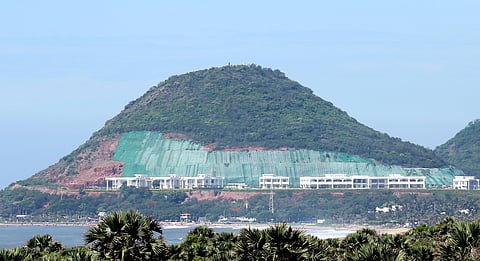

VISAKHAPATNAM: A 10-year environmental monitoring programme, and a comprehensive restoration plan for Rushikonda hill have been recommended by a Centre-appointed expert committee, which has found that hill cutting, excavation, levelling and dumping of construction waste caused substantial environmental damage to the hill and adjoining coastal areas.
The committee has called for the removal of excavated soil, muck and construction and demolition waste dumped outside the approved project area, including material deposited in Coastal Regulation Zone (CRZ) areas.
It has also recommended that the project proponent bear responsibility for preparing and implementing an approved Environmental Restoration Plan (ERP), including ecological rehabilitation and monitoring.
The recommendations form part of the committee’s report submitted to the High Court in the Public Interest Litigation (WP(PIL) No. 241 of 2021), filed by former JSP corporator Peethala Murthy Yadav.
The matter came up before the Chief Justice’s bench on November 25.The committee observed that the activities had substantially altered natural topography of Rushikonda hill, and affected adjoining coastal environment. Its assessment identified dumping at several locations, including Totlakonda (3.38 acres), Managamaripeta and Ramadri (9.67 acres), Uppada (2.76 acres), Kapuluppada (14.70 acres), Yendada (0.13 acres) and the south-eastern side of Rushikonda hill (4 acres). Chepaluppada was listed as a proposed dumping location.
The report flagged damage to vegetation and habitats due to hill-slope alteration and dumping in plantation and CRZ areas. It noted that the removal, burial and fragmentation of vegetation could reduce habitat availability and disrupt ecological connectivity, recommending a seasonal inventory of flora and fauna.
It also warned that changes to natural drainage patterns could increase runoff velocity and sediment loads, raising the risk of erosion, sedimentation and slope instability.
Cut and dump slopes could be vulnerable to gullying, slumping and localised failures without appropriate engineering and bioengineering measures.
The committee noted that the altered hill profile, exposed cut faces, large built structures and off-site dumping had affected the scenic character of the coastal landscape, with impacts visible from public viewpoints, beaches and approach roads.
The committee recommended baseline and post-monsoon monitoring of surface water, groundwater and air quality. While waste removal, regrading and ecological restoration could reverse some damage, changes to the original landform and mature habitats might be partly reversible.
The restoration plan includes slope stabilisation, drainage restoration, soil rehabilitation and native vegetation, with monitoring for at least 10 years.
