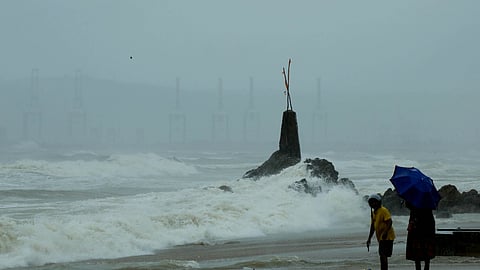

VISAKHAPATNAM: For a few hours on October 28, Very Severe Cyclonic Storm Arnab remained almost motionless over the west-central Bay of Bengal, even as it carried winds of up to 125 kmph and threatened the Andhra Pradesh coast with destructive winds, torrential rain and storm surge.
Its pause, according to a retired ocean scientist, may have been the result of competing weather systems interfering with the cyclone’s forward movement.
Dr K.S.R. Murthy, retired scientist from the National Institute of Oceanography, attributed the prolonged stationary phase to a complex atmospheric setting involving strong westerly winds, another developing low-pressure area over the Bay of Bengal and a developing cyclone in the Myanmar region moving in the opposite direction.
“Generally, this happens when the track of a cyclone is resisted by opposing forces,” he explained, noting that the interaction of these systems could have pushed Arnab backwards or restricted its movement.
The India Meteorological Department on October 28 captured the unusual situation. Arnab was reported to be practically stationary over the west-central Bay of Bengal, near latitude 16.4°N and longitude 82.0°E, around 30 km east of Narsapur, 45 km south-southwest of Yanam and 70 km south-southwest of Kakinada.
Despite its limited movement, the storm retained considerable strength, with estimated sustained wind speeds of 115-125 kmph and gusts reaching 140 kmph.
The IMD said the landfall process would continue for the next two hours while the system remained practically stationary.
A cyclone does not move independently of its surroundings. While its internal circulation determines its structure and intensity, its forward movement is influenced by the larger atmospheric circulation, including prevailing winds and nearby pressure systems.
When these surrounding conditions interact in competing directions, the steering flow that ordinarily guides a cyclone may become weak or complicated. The system can consequently slow down, change direction or remain nearly stationary for a period.
In Arnab’s case, Dr Murthy identified three interacting systems that, in his assessment, contributed to the slowdown. Strong westerly winds were pushing against the cyclone’s movement, while a separate low-pressure area was developing over the Bay of Bengal. A developing cyclone near Myanmar added another element to the complex weather pattern.
“The complex weather systems prevailing in the Bay of Bengal are responsible for slowing down or keeping Arnab stationary,” he explained.
The precise contribution of each system would, however, need to be established through detailed meteorological analysis.
