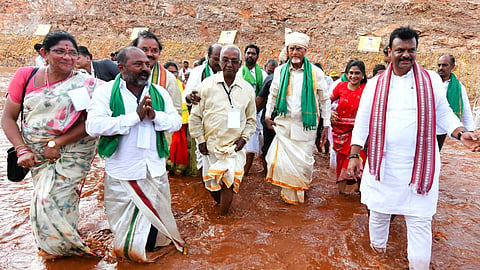

VISAKHAPATNAM: A decades-old aspiration of North Andhra moved closer to reality on Wednesday as Chief Minister N Chandrababu Naidu formally welcomed Godavari waters through the Polavaram Left Main Canal by performing ‘Jala Harathi’ at Sitarampuram in Payakaraopeta mandal of Anakapalli district.
The release marks a significant milestone in the utilisation of the Polavaram Left Main Canal, which traverses the difficult terrain of the Eastern Ghats through tunnels, aqueducts and a siphon beneath the Yeleru river. The 213-km canal is designed to carry 23.44 TMC of Godavari water for irrigation, drinking and industrial requirements.
The first phase of the release is expected to benefit about 2.87 lakh acres of ayacut and 5.23 lakh people across four districts. In Anakapalli alone, around 1.5 lakh acres are expected to receive irrigation support.
North Andhra will become growth centre with Godavari waters: Naidu
The government has also drawn up plans to use the water to fill the Yeleru canal and 110 tanks.
The water will pass through the Yeleru, Pampa, Tandava, Varaha and Sharada river systems.
The release is expected to stabilise 1.48 lakh acres under the Pushkara irrigation zone, including 80,700 acres under Yeleru and 12,000 acres under Pampa, besides another 46,620 acres in the Tandava, Varaha and Mamidi Gedda zones.
Addressing a public meeting at Payakaraopeta, Naidu announced that the government would expand the Left Main Canal and link it with the Uttarandhra Sujala Sravanthi project to take Godavari waters to the upland areas of Anakapalli, Visakhapatnam, Vizianagaram, Parvathipuram Manyam and Srikakulam districts.
“Instead of people migrating out of Uttarandhra, people will migrate to Uttarandhra,” Naidu remarked, asserting that the region would emerge as a major growth centre.
He announced that the government would complete 36 projects at a cost of Rs 35,000 crore over the next three years, while Rs 25,000 crore had already been spent on irrigation during the last two years. He noted that the Left Main Canal had cost around Rs 4,192 crore so far.
Its construction involved several major engineering challenges, including a siphon beneath the Yeleru river and aqueducts across the Pampa and Tandava rivers.
