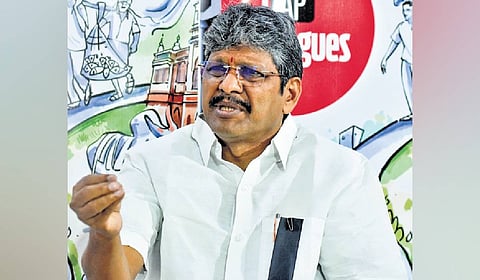

On the State government’s claim of clearing `30,000 crore in employee dues, AP JAC Amaravati Chairman Bopparaju Venkateswarlu says much of the amount represents employees’ own savings and statutory payments, while actual accumulated arrears remain at `40,000-50,000 crore. He also discusses the union’s support base, earlier agitations and its likely course after negotiations.
Excerpts
Why are you being forced to resort to agitation?
The main reason is that statutory dues and arrears have remained unresolved for months despite continuous dialogue. We extended full cooperation to the government for over two years, keeping in mind the State’s financial position, and held multiple rounds of detailed discussions with a five-minister committee and senior IAS officials.
After the meetings, we waited for about 40 days for clear communication on which decisions would be implemented, which demands would be deferred and what the timeline for resolution would be. When no official roadmap materialised, and retired employees continued to face severe financial hardship without receiving their hard-earned statutory benefits, organised agitation became our only recourse to protect our members.
Are all employee associations joining the APJAC Amaravati protests?
APJAC Amaravati is a broad federation representing departmental associations across every level — from VROs to Deputy Collectors in the Revenue Department, as well as the Police Officers Association, Government Doctors Association, engineering cadres, Grama/Ward Sachivalayam staff, PTD (RTC) workers and Retired Employees Associations.
Our strength lies in these specialised departmental bodies, which represent hundreds of thousands of serving and retired personnel across all 28 districts. Representatives and district presidents are fully aligned with our movement because these unresolved grievances affect employees across every department.
How many DA instalments are pending, and what is the status?
There are currently five pending Dearness Allowance (DA) instalments, amounting to a 12% adjustment. Accumulated DA arrears alone account for approximately `10,000 crore of the overall pending dues. Employees are anxiously awaiting a clear explanation and commitment from the government on the release schedule for these long-pending instalments.
What do you expect from the government?
We want concrete clarity and on-record commitments rather than vague assurances. Specifically, we are seeking immediate appointment of the PRC Commissioner. The 11th PRC came into force on January 1, 2022, and the next revision is due from January 1, 2027. Without a commissioned body, there is no formal mechanism to prepare the report. We also want declaration of Interim Relief (IR). Employees have already lost three years of IR benefits due to delays. Immediate clearance of IR is therefore essential.
Pay-slip accounting is also a crucial issue. All pending dues and partial releases should be clearly reflected on official pay slips so that surviving family members have documentary evidence if an employee dies suddenly.
What is your next step after the Joint Staff Council meeting?
We view the government’s invitation for negotiations as an initial victory, but not the final resolution. A meaningful outcome requires concrete clarity on Interim Relief, appointment of the PRC Commissioner, release of pending DA instalments and settlement of retired employees’ dues.
We are entering the meeting with a positive outlook, but our planned lunch-hour ‘Demands Day’ demonstrations will proceed as scheduled while we negotiate. Presidents from all 28 districts are arriving in Vijayawada. After the discussions, we will deliberate with our executive body and decide our next course of agitation.
What accounting mechanism are you seeking for pending employee dues?
We have made a direct demand. All pending dues and partial releases should be clearly reflected on official pay slips. For instance, if an employee is owed `22,000 in DA arrears and the government releases `5,000 this month, the remaining `17,000 should be explicitly recorded on the pay slip.
This is critical because, following the COVID-19 pandemic, we have seen employees in their early 40s die suddenly due to health complications, including two employees aged 40 at the Machilipatnam Collectorate.
In another case, a 72-year-old retired employee at a Tahsildar’s office died without receiving his pending dues or gratuity, leaving his three elderly sisters helpless under the existing bloodline rules.
If an employee dies, the surviving family must have an official record to claim the benefits earned by the employee. Without a clear ledger entry on the pay slip, those hard-earned savings can get lost in administrative ambiguity.
The government says the coalition has been clearing the previous government’s employee dues. Why have you not mentioned this?
We have always acknowledged and appreciated the government whenever positive measures were taken, including specific payments cleared after the coalition government came to power.
However, the `30,000 crore figure quoted by the government consists almost entirely of mandatory disbursements from employees’ own accumulated savings, such as General Provident Fund (GPF) withdrawals, APGLI payouts and CPS contributions, where the state acts merely as a legal trustee. It also includes routine gratuity payments to around 43,000 natural retirees.
Releasing an employee’s own savings back to them is a statutory duty, not a special clearance of state arrears. Total actual accumulated arrears, including PRC arrears, pending DA arrears and surrender leave encashment, still stand between `40,000 crore and `50,000 crore.
How do you view the present administration’s stance in light of Chandrababu Naidu’s earlier tenure?
Looking at historical precedents, when the State was bifurcated and operating under severe financial constraints, Chief Minister Chandrababu Naidu Garu granted a 43% fitment. Before leaving office in 2019, his administration issued an order offering 27% IR.
Under statutory guidelines, employees are legitimately owed 27% IR and 14.8% from the preceding period. While fitment levels depend on executive discretion, statutory dues are mandatory entitlements. We are not asking for anything for free. Just calculate the difference and settle what is legally owed.
Minister Anagani accused you of organising a convention to demean CM Naidu. Did the programme cross the line into personal political disrespect?
Why were these accusations not raised over the last two-and-a-half years, while we maintained active dialogue? During the 2014-19 administration, we published a booklet highlighting the developmental work completed by Chief Minister Chandrababu Naidu Garu and explicitly thanked him on the final page. Was there a conspiracy then? Under the previous regime, I led a 92-day solitary struggle on the streets, questioning where employee GPF funds had gone. It was covered extensively by major daily newspapers. Questioning whichever government is in power over legitimate rights is our fundamental trade union duty.
As for displaying video clips at MBVK Bhavan, how can replaying public statements made in front of thousands during an election campaign constitute defamation? Leaders publicly assured us that employee interests would be protected and PRC benefits provided. Replaying those promises in their own words is a reminder to the leadership of commitments already made, not an act of disrespect.
Regarding the satirical cutouts outside the venue, we had zero involvement. Heavy police security was present outside and anyone could have placed them. As a senior Revenue officer in my 40th year of service, I would never sanction such crude antics. Our official programme inside was dignified and strictly focused on employee rights.
What if the government does not agree to your demands?
We will hold discussions and decide our next step. We are sitting down together to talk and continuing our demonstrations while attending the talks. After consulting representatives from all 28 districts, we will take a collective decision based on the outcome of the meeting.
‘Show all employee dues on pay slip’
All pending dues of State government employees and partial releases should be clearly reflected on official pay slips. This is critical because, following the COVID-19 pandemic, we have seen employees in their early 40s die suddenly due to health complications, including two employees aged 40 at the Machilipatnam Collectorate
