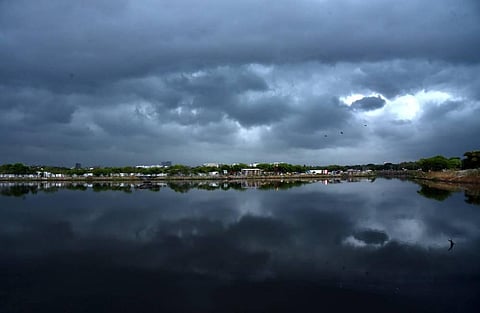

VIJAYAWADA: Andhra Pradesh is once again facing a severe weather and agricultural challenge as the strengthening El Niño phenomenon disrupts the southwest monsoon, reviving memories of earlier episodes when rainfall shortages, heatwaves and drought severely affected the State, reviving the memories of the previous episode in 2015.
According to the IMD, the State received only 204.8 mm of rainfall against the normal 378.6 mm between June 1 and September 5, registering a deficit of 46%. As many as 23 of the 26 districts recorded deficient rainfall, while three districts experienced deficient rainfall.
The sharp shortfall has raised concerns over kharif agriculture, reservoir storage and drinking-water availability. The IMD has forecast below-normal rainfall and above-normal temperatures over most parts of Andhra Pradesh during September, raising the possibility of continued weather stress during the crucial final phase of the monsoon.
The impact is already visible in temperatures. Day temperatures in several parts of Coastal Andhra and Rayalaseema were three to six degrees Celsius above normal. Tirupati recorded 39.4°C, Nellore 39.2°C and Kavali 39°C. Strong heat conditions were reported particularly in southern Coastal Andhra and adjoining Rayalaseema districts.
The IMD has documented a clear association between several El Niño years and deficient southwest monsoon rainfall. Its historical data show significant deficits in Andhra Pradesh during years including 1963, 1968, 1972, 1982, 1987, 1994, 2002 and 2004. The 2002 episode was particularly severe, with Andhra Pradesh recording a 39.7 per cent southwest monsoon deficit against its normal seasonal rainfall of 521.6 mm.
The developing situation across the state has revived memories of severe El Niño years. A strong El Niño contributed to an intense heatwave across India that claimed at least 2,300 lives nationally, including 1,369 in Andhra Pradesh.
The scale of the disaster prompted the State to establish the Andhra Pradesh State Disaster Management Authority, placing heatwave preparedness on a more institutional footing. Earlier El Niño years, including 1972, 1997, 2002 and 2009, were also associated with elevated temperatures and rainfall stress.
The 2023 episode was comparatively milder. IMD data show that 2023 was a weak El Niño year, with India’s southwest monsoon recording a 5.3% deficit nationally. Andhra Pradesh too experienced a relatively limited monsoon shortfall compared with the worst El Niño years.
“However, 2026 is emerging as a much more serious test. We had warned in the month of May that ENSO conditions were transitioning towards El Niño and that the phenomenon was likely to develop during the southwest monsoon,” said the IMD officials.
“The recurring pattern also highlights that El Niño does not necessarily produce identical conditions every time. Its impact depends on its intensity, timing and interaction with other ocean-atmosphere factors. For a State heavily dependent on monsoon rainfall, however, every major El Niño remains a warning that preparedness must begin well before the rains fail,” the IMD officials added.
According to IMD data, Andhra Pradesh had received about 204.3 mm of rainfall against the normal 369.5 mm, a deficit of nearly 45 percent by the end of August.
Chief Minister N Chandrababu Naidu has warned that the 2026 situation could cause prolonged stress to agriculture and water resources. He said the State was projected to receive only about 557 mm of rainfall between June and December against a normal 867 mm. The government has focused on crop diversification, water conservation, crop insurance and contingency planning.
