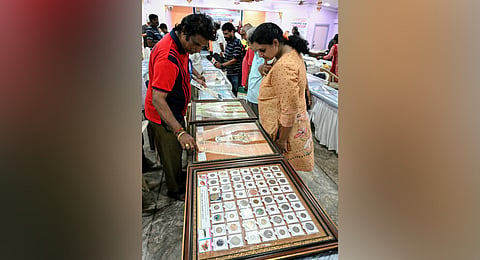

VISAKHAPATNAM: The world’s first polymer and silk currency notes, a gold and silver banknote made with 23-carat gold and pure silver, and a tiny silver coin measuring just 3 to 4 mm are among the unusual exhibits at a three-day numismatic and philatelic exhibition in Visakhapatnam.
The exhibition, organised jointly by the Numismatic and Philatelic Society of Visakhapatnam and the Lions Club of Visakhapatnam, began on Friday, bringing together collections of around 30 members from Visakhapatnam, Vizianagaram, Srikakulam, Anakapalli, East Godavari, West Godavari and Bengaluru.
The collections span centuries, with coins dating back to 300 BC displayed alongside modern currency, stamps and postal cards. Gold and silver coins associated with the Satavahanas, Ikshvakus, Kushans, Cheras, Cholas, Pandyas and British rulers are among the exhibits.
One of the smallest exhibits is a silver Mashaka, measuring around 3 to 4 mm and weighing about 180 mg. It is described at the exhibition as one of the smallest coins in the world. The information displayed alongside it says Mashakas are believed to have circulated in north-western or western India between the 5th and 3rd centuries BC.
At the other end is a one-kilogram silver coin featuring an Australian koala. The exhibition also features a wooden currency note from Austria dated 1920 and currency notes made of aluminium.
The stamp section includes a seashell stamp issued by China for the Asian Games, a football-material stamp issued by Austria, an embroidered stamp issued by Swiss Post and an Austrian stamp containing 0.03 grams of meteorite dust. A Bhutanese talking stamp, described at the exhibition as playable on a gramophone at 33 rpm, is also on display.
The exhibits include pure gold stamps and gold-plated stamps issued by the Indian Postal Department. There are also Indian fancy-number notes, star notes and notes carrying matching serial numbers.
One collection has 725 Rs 10 notes with the same serial number arranged around an image of Lord Venkateswara Swamy. Notes with matching serial numbers are also displayed.
The exhibition has attracted collectors with different interests. K. Gouri Siva Suresh, a self-employed electrical technician, has displayed foreign coins featuring birds and animals. He said his collection aims to create awareness about birds and promote the message of saving trees and birds.
A 25-year-old collector, who started seriously collecting coins about five years ago, began with foreign coins kept by his father. He later learnt about coins through books and YouTube and gradually built his collection. He is now collecting British India coins and sharing information about numismatics through YouTube and Instagram.
For a retired teacher, collecting coins is also a way of teaching. He said he collected the coins to show them to his students and help them learn about them.
J.B. Narayana, a Mathematics teacher, continued his father's hobby and has collected Mathematics-themed stamps featuring Nicolaus Copernicus, Sir Isaac Newton and Carl Friedrich Gauss. Ravi Shankar Karakavalasa has displayed 73 varieties of coins representing European kingdoms, Portuguese colonies and territories and former nations. Another collection, recognised in the Limca Book of Records 2026, comprises 230 wildlife and fish-themed coins from 90 countries.
Visitors of different age groups, including families with children, visited the exhibition on Friday. The exhibition will remain open from 10 am to 6 pm on Saturday and from 10 am to 4 pm on Sunday. Entry is free.
