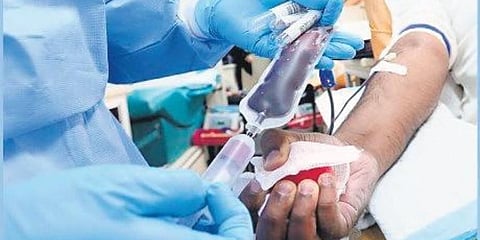

NEW DELHI: Delhi Chief Minister Arvind Kejriwal on Friday announced that the Centre had given permission to conduct more plasma therapy for treating Covid-19 patients and said the Lok Nayak Jayaprakash Narayan Hospital and the Rajiv Gandhi Super Speciality Hospital would offer this line of treatment.
“We have received permission to do more plasma therapy treatment in Delhi. We are now offering plasma therapy treatment in LNJP and the Rajiv Gandhi Hospital,” Kejriwal said after a cabinet meeting. The CM said plasma therapy was found to be effective in moderate cases that do not have extreme comorbidities and that a few private hospitals were also offering this service.
Kejriwal’s announcement came on a day when Health Minister Satyendar Jain, who was diagnosed with Covid-19 and was administered plasma therapy, tested negative. The Institute of Liver and Biliary Science was monitoring the entire plasma therapy treatment to patients in Delhi. The treatment is based on the premise that blood from a recovered patient contains antibodies with the ability to fight the pathogen.
It is mostly effective on patients in the second stage before the third stage where there is a chance of failure of vital organs of the infected person. The CM said although the number of fresh cases remains high, the situation was under control. According to the Delhi government, the rise in number of cases was because of increased testing and it was “natural” that there will be a spike.
Two types of testing were being applied, the rapid antigen test and the RT PCR test. Kejriwal said the “good news” was that the recovery rate among coronavirus patients was high. The CM said the number of beds currently stands at 13,500. “It is not that we are not doing anything, even though we do not require more beds at the moment, we are preparing for tomorrow.
In the first week of June we did face some issues regarding availability of beds. But now the situation is under control,” he said. Kejriwal said the government had started distributing pulse oximeters which will act as ‘suraksha kawach’ for patients to monitor oxygen levels.
