
In Tom Vattakuzhy’s world, silence is never empty. ‘The Shadows of Absence’, his solo exhibition in India at Vadehra Art Gallery in Delhi, brings together 16 works that capture the interiors of Kerala’s domestic life while quietly probing the themes of migration and absence. Curated by art historian R Siva Kumar, the show is an opportunity to encounter the Kerala artist’s paintings in India, after years of his practice away from the spotlight. It is the last day today.
“In these works, light and shadow, presence and absence, weave in and out of each other—sometimes faintly, sometimes with striking clarity,” Vattakuzhy reflects, adding that the title itself, suggested by Siva Kumar, sets the tone for the viewing.
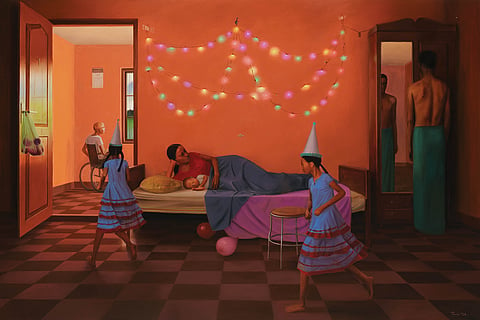
A recurring theme in his canvases is figures inhabiting the same room, yet rarely the same world. Take Birthday, where a family unfolds within the triptych’s three divisions. The grandfather sits in a wheelchair staring out of a sunlit window, the young father looms before a shadowed mirror, and at the center, children run around in birthday hats while their mother rests beneath a wash of pink light and fairy lights. The painting makes absence palpable—even in togetherness, the figures remain divided, elsewhere.

That sense of elsewhere is deeply tied to Kerala, where migration has long shaped domestic life. “Increasingly, I feel that many of Kerala’s houses are slowly transforming into spaces that resemble old-age homes, with the elderly left behind as the younger generations move away,” he says. His works become quiet reflections on this reality, carrying the mood of a household marked by longing.
If men in his paintings often appear as distant silhouettes, it is the women who anchor his canvases, caught between resilience and vulnerability. For Vattakuzhy, portraying them feels akin to inhabiting another life. “Experience becomes the nourishment for any creative act. Everything one has seen, known, and lived through inevitably finds expression in painting,” he explains. His women, lit by both sunlight and shadow, embody the weight of endurance, their inner lives suspended between visibility and silence.
Absence itself, however, is not just a void in his works—it becomes a subject in its own right. “Often, it even becomes the very subject of the painting,” he says. In an era crowded by noise and speed, Vattakuzhy treats absence as a counterweight: a silence that unsettles, invites reflection, and lingers long after the viewing.
Though rooted in the domestic interiors of Kerala, his works resonate universally. At a recent exhibition in Kolkata, a group of young women told him they fell into an unusual, shared quiet before his paintings. “Each painting carried something that moved us deeply,” he recalls.
Drawing from literature, cinema, music, and philosophy, he takes inspiration from Dostoevsky and Hermann Hesse to Thich Nhat Hanh and O.V. Vijayan. Yet art remains an endless chase for him — “like a carrot tied before a donkey”. Each canvas holds the restlessness of incompleteness, but also a fragment of fulfillment—where shadows speak as strongly as the figures themselves.