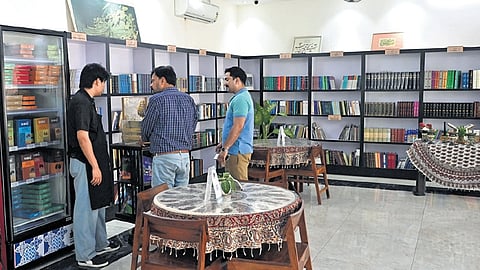

NEW DELHI: Soft strains of Persian music float through the air as sunlight filters through wide glass windows, gently falling on shelves lined with books on mysticism, poetry, and Iranian history, along with beautiful handicrafts. The aroma of caramelised Iranian dates lingers, blending with the delicate fragrance of saffron and dried rose buds steeping in tea.
Tucked along Supreme Court Road, between the Iran Culture House and the Delhi College of Art, Irani Mehfil Cafe feels less like a commercial space and more like a cultural passage— an invitation into Iran in the heart of Delhi.
The cafe, which opened last year, stands on what was once an old library housing volumes on Iranian culture and history. Its transformation was not accidental but intentional. The President of the Iran Culture House envisioned a space that would take Iranian culture beyond institutional walls and introduce it to a wider Indian audience. “He didn’t want to confine Iranian culture within the house. He wanted it to reach different strata of Indian society,” said the founder of the cafe, Mehdi Shirmohammadi.
Shirmohammadi, an Iranian entrepreneur who runs a company in Chandigarh, imports saffron and dry fruits directly from Iran. At the cafe, authenticity is key. The menu, though still evolving, centres around traditional offerings like saffron tea, orange blossom tea, and Persian aromatic black tea—distinctly different from the milk-based brews common in India. The cafe also offers Indian tea, albeit with a slightly creamy texture.
Explaining the name ‘Mehfil’, Shirmohammadi said, “The name ‘Mehfil’ itself reflects a cultural bridge. While rooted in Persian linguistic traditions, it is a word deeply familiar to Indians, evoking a sense of gathering, warmth, and shared experience.

We wanted something people here would instantly connect with. Also, the best part is that we offer people a place to come, sit and work from our cafe…”
Beyond tea, the cafe doubles as a living cultural exhibit. Iranian handicrafts adorn the space, while books ranging from contemporary fiction to classical poetry, children’s literature, and translations of the Quran invite visitors to linger. Plans are underway to expand into an open garden seating area within the Culture House premises, further blurring the lines between a cafe and a cultural hub.
Interestingly, Delhi’s small but evolving Iranian cafe scene is not without contrasts. In Daryaganj, a cafe called Iranian Dum Chai claims to serve “original” Iranian tea alongside bun malai maska—a combination more rooted in Indian cafe culture. Mohammadi, however, pointed out that traditional Iranian chai does not include milk, highlighting how authenticity often gets reinterpreted across borders. The Daryaganj cafe also experiments with fusion offerings like Ajwa khajoor ice cream, blending Middle Eastern ingredients with local tastes.