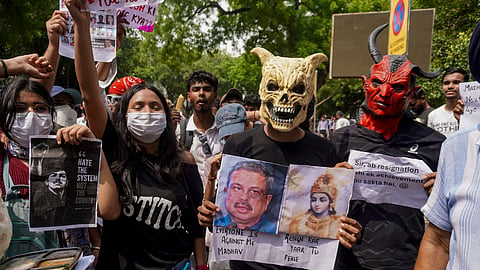

The outrage over the language used by some protesters at Delhi’s Jantar Mantar has almost become a story in itself. Videos of young demonstrators hurling abuses at the Prime Minister flooded social media, prompting strong reactions from across the political spectrum. However, if public debate ends with condemnation of their vocabulary, it risks overlooking a much larger and more uncomfortable question.
A much-respected senior police officer gently reminded that democratic rights carry democratic responsibilities. “The manner in which these protests were conducted and concluded are also a testimony to the health and strength of democracy in India,” he observed before adding, “Can we have less profanity to express your anger at the establishment please?... The right to protest is not diminished when expressed in polite and temperate language.”
Actor and MP Kangana Ranaut described sections of the protesters as “Generation Gutter”, saying many young people wanted the privileges of independence without its responsibilities. Her remarks sparked controversy. Both reactions, raise the question of why did the language of these young protesters come as such a revelation to many public figures? For the thousands of teachers across India’s universities, it was no revelation at all.
Ask any faculty member who has taught undergraduates over the past four years, especially students who completed Class XII between 2020 and 2022. This ‘Covid generation’ missed classrooms, playgrounds, debates, sports and everyday peer interactions during their formative years, affecting emotional and social development.
Their socialisation shifted almost entirely to digital platforms where outrage attracts engagement, algorithms reward extremity, and anonymity often removes the restraints that normally govern human conversation. When these students finally entered colleges, many appeared withdrawn inside classrooms. Participation was hesitant. Conversations were sparse. Confidence seemed fragile. Yet beneath that quiet exterior often lay an entirely different personality waiting to emerge online or during moments of confrontation.
Ordinary disagreements could suddenly escalate into aggressive exchanges; vocabulary would turn coarse. What shocked many teachers initially slowly became something they learned to manage rather than merely condemn. This behavioural shift reflected a deeper transformation in how an entire generation has learnt to communicate. The pandemic interrupted not merely academic learning but emotional development as three crucial years of this social learning disappeared almost overnight.
Smartphones became classrooms, playgrounds and social spaces rolled into one. Digital culture normalised a style of communication that rewards instant reaction rather than thoughtful reflection. Viral content is rarely nuanced. It is provocative, sarcastic and often abusive because outrage travels faster than reason.
When these students eventually entered public life, many brought this digital vocabulary with them. This phenomenon is not confined to universities. Rising concerns over juvenile crime, online bullying, mental health challenges and increasingly volatile interactions in educational institutions point towards a broader social transition. Yet there has been remarkably little systematic public conversation about the long-term psychological and behavioural consequences of growing up during the pandemic.
Today’s youth deserve efforts at understanding. That does not mean excusing abusive behaviour. Democracies cannot flourish if public discourse degenerates into insults. The police officer was right in saying that the strength of a protest is not measured by the harshness of its vocabulary. Civility strengthens dissent rather than weakens it.
At the same time, reducing the Jantar Mantar protests to the profanity of a few viral reels misses the larger mosaic. The abusive slogans were visible because social media amplifies spectacle. They were not necessarily the defining feature of the protest itself. To make them the sole takeaway is to confuse one tile for the entire picture. The real challenge before India is not how to silence an angry generation but how to re-engage it.
Sidharth Mishra
Author and president, Centre for Reforms, Development & Justice
