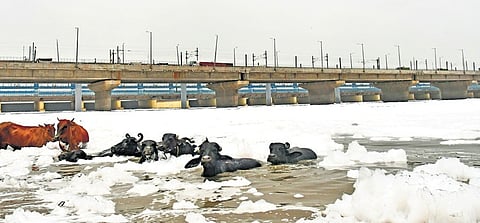

NEW DELHI: Faecal coliform levels in the Yamuna showed a slight improvement at several monitoring locations in July compared with June, indicating a marginal reduction in untreated sewage entering the river. However, pollution levels remain far above permissible limits, while Biological Oxygen Demand (BOD) readings continue to paint a grim picture of the river’s health, according to the latest Delhi Pollution Control Committee (DPCC) report.
The DPCC monitors the river’s water quality every month by collecting samples from seven locations in Delhi—Palla, Wazirabad, ISBT, ITO, Nizamuddin Bridge, Okhla Barrage and Asgarpur in Haryana. The samples are tested for parameters including BOD, dissolved oxygen, chemical oxygen demand, pH and faecal coliform to assess pollution levels.
The July report showed improvement in faecal coliform levels at four locations. At Palla, the count declined from 2,800 MPN/100 ml in June to 2,100 MPN/100 ml in July. Wazirabad recorded a drop from 4,300 to 3,500 MPN/100 ml, while ITO Bridge improved from 140,000 to 120,000 MPN/100 ml. Asgarpur also registered an improvement, with levels declining from 390,000 to 320,000 MPN/100 ml.
Faecal coliform levels remained unchanged at ISBT Bridge (170,000 MPN/100 ml) and Okhla Barrage (110,000 MPN/100 ml). However, Nizamuddin Bridge recorded a slight deterioration, with the level rising from 120,000 to 130,000 MPN/100 ml.
Despite the improvements, all locations except Palla continued to record faecal coliform levels well above the desirable limit of 500 MPN/100 ml and the permissible limit of 2,500 MPN/100 ml. The report also highlighted persistently high BOD levels, which indicate the amount of oxygen required by microorganisms to decompose organic matter in water.
Report also highlights persistently high BOD levels
The report also highlighted persistently high Biological Oxygen Demand (BOD) levels, which indicate the amount of oxygen required by microorganisms to decompose organic matter in water. Higher BOD levels reflect greater pollution and reduced oxygen availability for aquatic life. BOD values in July ranged between 2 mg/l.
