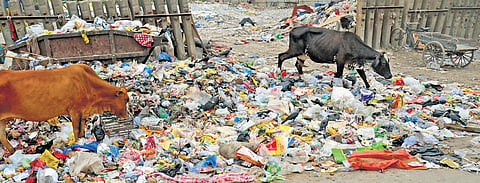

NEW DELHI: The first part of this series examined how mixed waste, weak enforcement and inconsistent collection practices undermine the city’s waste management system at its very first step. But even if every household and commercial establishment segregated its garbage perfectly, the national capital would still face another structural challenge; it does not have enough infrastructure to process all the waste it generates each day, though authorities are working to expand capacity.
The Municipal Corporation of Delhi (MCD) is working towards an ambitious roadmap to expand the national capital’s waste-processing capacity by 13,550 tonnes per day (TPD) with the help of new waste-to-energy (WTE) plants, expansion of existing facilities and fresh waste-processing projects. This move is aimed at bridging the widening gap between waste being generated and the one being processed.
According to official data accessed by this newspaper, the proposed projects, expected to be completed in phases between 2026 and 2028, would increase Delhi’s waste-processing capacity from the existing 7,841 TPD to over 21,000 TPD.
This comes at a time when Delhi generates nearly 14,000 metric tonnes of municipal solid waste every day. The MCD, the primary agency responsible for waste management across most of the city, currently has an installed processing capacity of only 7,841 TPD.

Considering that the civic body is responsible for managing waste in nearly 90-95% of the capital, the numbers indicate that the city may still be facing a processing shortfall of 6,000 tonnes daily, thereby putting continued pressure on the city’s landfill sites.
According to the MCD’s plans, 7,650 TPD of additional capacity will be created through new and expanded WTE and compressed biogas (CBG) facilities. This will include a 3,000 TPD WTE plant at Narela-Barwana, a 2,000 TPD WTE plant at Ghazipur, expansion of the Okhla and Tehkhand WTE plants by 1,000 TPD each, along with new CBG facilities proposed at Okhla and Ghazipur.
Apart from that, the civic body also has five new waste-processing facilities in the pipeline with a combined capacity of 5,900 TPD at Bhalswa, Shinghola, Okhla, Bawana and Ghazipur.
Chairman of Department of Environmental Management Services (DEMS), MCD, Sandeep Kapoor said, “We are working on two major initiatives. One involves five waste-processing projects with a combined capacity of 5,900 metric tonnes, while the other focuses on expanding our waste-to-energy plants. Our target is to create processing capacity that exceeds the quantity of waste generated every day.”
Kapoor further said that the municipal body aims to create an additional 8,000-9,000 metric tonnes of processing capacity within the next one-and-a-half years through projects being implemented in phases.
Despite such enormous plans of expansion, waste management experts warn that infrastructure expansion alone will not resolve Delhi’s waste crisis unless segregation at source improves.
“Segregation is a non-negotiable fundamental criterion for any waste management system. Without segregation, you cannot think of a sustainable waste management system anywhere. When you collect mixed waste, you lose half the battle there, because technologies that claim they can segregate waste later have not really worked at scale,” an expert working from the Solid Waste Management sector said.
He further mentioned that waste-to-energy plants are designed primarily to utilise non-recyclable dry waste and not mixed municipal waste containing large quantities of wet, biodegradable material.
“Waste-to-energy is supposed to use dry, combustible waste as fuel. It isn’t designed to burn wet waste with high moisture content. Cities should therefore strengthen segregation and process wet and dry waste through appropriate technologies rather than depending on a single solution,” he added.
As of now, Delhi’s processing infrastructure is dominated by four major facilities, which are the integrated waste-processing plant at Narela-Bawana and the waste-to-energy plants at Okhla, Ghazipur and Tehkhand.
All these facilities together account for the overwhelming majority of the city’s treatment capacity. On the other hand, decentralised infrastructure such as composting units, material recovery facilities and compressed biogas plants continues to account for only a small share of the overall processing ecosystem.
The proposed expansion is expected to strengthen the national capital’s ability to scientifically process fresh waste while reducing dependence on the Ghazipur, Bhalswa and Okhla landfill sites, which continue to receive municipal waste alongside the ongoing biomining of legacy garbage.
Processing shortfall of 6,000 tonnes daily
Considering that the civic body is responsible for managing waste in nearly 90-95%, the numbers indicate that the city may still be facing a processing shortfall of 6,000 tonnes daily, thereby putting pressure on the city’s landfill sites.
Four major facilities
Delhi’s processing infrastructure is dominated by 4 major facilities—integrated waste-processing plant at Narela-Bawana and the waste-to-energy plants at Okhla, Ghazipur and Tehkhand.