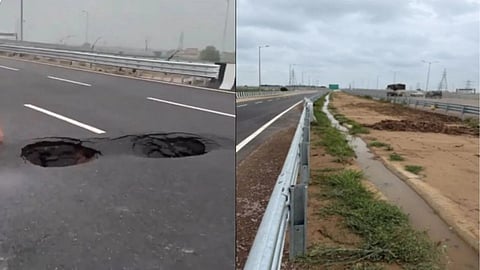

NEW DELHI: The National Highways Authority of India (NHAI) on Thursday said the road cave-in on the newly constructed Delhi-Dehradun Economic Corridor was caused by localized water stagnation after heavy rain and the non-operational cross-drainage system at the site.
A portion of the expressway, inaugurated in April, caved in on Tuesday near Gogwan Jalalpur in Uttar Pradesh's Shamli district.
The Ministry of Road Transport and Highways (MoRTH) said the damaged stretch was identified immediately and repaired to restore traffic. “A road surface cave-in observed at Km 55+480 on the Delhi–Dehradun Economic Corridor on 1 July 2026 was the result of localised water stagnation following rainfall on the previous night, coupled with constraints in commissioning the permanent cross-drainage system at the location…The damaged portion was repaired on priority, ensuring safe and uninterrupted movement of traffic,” the ministry said.
The ministry said a balancing culvert had been built to carry rainwater safely across the median but could not be made operational because local residents allegedly opposed connecting the drainage system and used the culvert opening as a vehicle crossing.
“The culvert could not be connected and commissioned because of sustained resistance from local residents, who have not permitted integration of the drainage system and have instead been using the culvert opening as a vehicular crossing. Consequently, the intended cross-drainage arrangement has remained non-operational, leading to accumulation of rainwater along the carriageway during the heavy rainfall and the subsequent road surface cave-in,” the ministry added.
The six-lane access-controlled expressway, built at a cost of Rs 12,000 crore, connects Delhi with Dehradun and passes through Baghpat, Baraut, Muzaffarnagar, Shamli and Saharanpur in Uttar Pradesh.
MoRTH also said permanent slope protection and chute drain works at the site remain pending because of a land-related arbitration dispute. “Despite repeated efforts by NHAI, the concerned landowners have not permitted execution of these works. As a result, the permanent protection measures envisaged under the project design could not be completed at the site,” it said.
The ministry said NHAI has started constructing an interim parallel drain of about 1.5 km and is redesigning the drainage gradient to safely carry rainwater until the balancing culvert becomes operational.
“NHAI is continuously monitoring the affected location and has deployed all necessary resources to ensure smooth and safe movement of traffic. The pending permanent slope protection and chute drain works will be taken up immediately upon resolution of the land-related dispute and availability of an unhindered work front,” it added.
