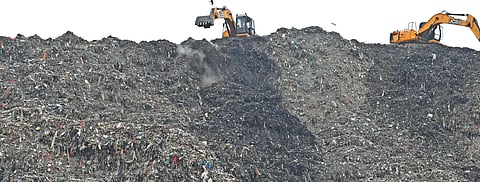

NEW DELHI: As the capital continues to face a structural challenge in terms of its waste management capabilities despite huge plans of infrastructure expansion, a ground check by TMS exposes the status of one of the three landfills in the city and the conditions of the people living around the site.
A 12-year-old Shajia walks barefoot in front of her house near the Ghazipur landfill with an ever-radiant smile on her face. She aims to be a mathematics teacher when she grows up, but her parents give her a reality check that it is a far-fetched dream.
The physical health of most children in the area shows signs of weakness. Her uncle said that like Shajia, many children in this locality have been physically weak since childhood; many also suffer from breathing problems.
Years of biomining and repeated promises to reclaim the garbage mountain continue, and so do foul odour, dust and respiratory discomfort in the lives of residents around the Ghazipur landfill. For the residents, the foul smell has become a usual phenomenon. It doesn’t bother them, but when an outsider steps into the locality, the smell compels them to put on a mask.
Even as authorities push ahead with remediation, the landfill still holds around 67 lakh metric tonnes (LMT) of legacy waste, making it the city’s biggest unfinished waste challenge and a stark reminder that the capital’s garbage crisis continues to be a public health concern for communities living in its shadow.

The Ghazipur landfill is one among the three legacy waste sites that the Municipal Corporation of Delhi (MCD) has been attempting to flatten through biomining. Even as the civic body continues to make progress at all three landfill sites, official figures show that millions of tonnes of legacy waste still remain to be processed before Delhi can finally get rid of its garbage mountains. Unlike Bhalswa and Okhla, which are expected to be flattened this year, Ghazipur needs an additional year due to the sheer scale of waste accumulated over decades.
Yet, for residents living around the landfill, the official timelines offer little relief. People residing in nearby colonies say the pungent smell from the landfill continues to fill their homes, particularly during the summer and monsoon months. Many complain of dust, swarms of flies and breathing discomfort, and the foul smell that seems to have become an unavoidable part of daily life.
Savita, one of the residents who has lived in the area for nearly 25 years, says, “The smell might have become usual for us, but the monsoon aggravates the problem. As strong winds blow across the area during the rainy season, the smell becomes even more distinct,” she said.
Savita further states that door-to-door waste collection has stopped in the locality for nearly a year now. “Earlier, an MCD vehicle used to come and pick the waste from our doorstep, but now since nobody comes, we stuff our garbage in a bag and hang it on our roofs,” she said while pointing out the garbage bags hanging from her building’s rooftop. “Later, we take those bags and dump them on land nearby,” she added.
Delhi’s landfill remediation programme revolves around biomining, a process through which old waste is excavated and passed through trommels, which are large rotating screening machines that separate soil-like material, recyclable components and refuse-derived fuel for further use.
This exercise forms a big part of the city’s long-term strategy to eliminate the long-standing garbage mountains that have become almost synonymous with Delhi’s waste management crisis. These open dumps are more than 30 years old but still waste being disposed of without any primary or secondary segregation.
Although biomining has reduced portions of the landfill over the years, the Ghazipur site remains one of Delhi’s most visible environmental challenges. Official progress figures reveal that Bhalswa still has around 26 lakh metric tonnes of legacy waste that is supposed to be processed. Around 35 acres of land have so far been reclaimed through biomining, while 24 trommel machines are currently deployed to process the old waste.
On the other hand, at Okhla, nearly 18 lakh metric tonnes of waste remains to be cleared. Here, biomining has helped reclaim around 25 acres, with 18 trommels operating at the site.
The two sites taken together still account for 44 lakh metric tonnes of legacy waste, underscoring the scale of work that remains even as the civic body races against the clock to meet its deadlines.
The figures also show contrasting progress. While Bhalswa has reclaimed more land, it continues to carry a significantly larger waste burden. On the other hand, Okhla has comparatively less waste left but still requires substantial remediation before it can be declared free of legacy waste.
However, with 67 lakh metric tonnes of waste still remaining at Ghazipur and another 44 lakh metric tonnes spread across Bhalswa and Okhla, the pace of biomining is expected to gear up more in the coming months.
The challenge becomes even greater as the capital continues to generate nearly 14,000 metric tonnes of municipal solid waste every day. Rapid urbanisation, increasing prosperity, and economic development coupled with changing lifestyles are some of the biggest contributors to this burning problem.
While the MCD has announced plans to substantially expand the city’s waste-processing infrastructure, fresh waste continues to enter the system even as decades-old garbage known as ‘legacy waste’ is being excavated.
Amit, a shopkeeper from the locality who has been living there since 1976, says, “People here suffer from many types of diseases, and many children were affected by pneumonia right after birth.”
For the residents living in the shadow of the Ghazipur landfill, the city’s remediation programme will not be measured only by official deadlines or tonnes of waste processed.
For children like Shajia, whose dreams and aspirations are bigger than the height of the landfills. It would be reflected in the day they can finally step outside their homes without the smell of garbage in the air and the looming presence of a mountain of waste dominating their neighbourhood.
But for now, the city still does not have enough infrastructural capability to process all the waste it generates each day, even when it is taking tiny steps every day towards a ‘cleaner’ future.
Waste collection stopped a year ago, says a local
A local of the Ghazipur landfill site, Savita stated that door-to-door waste collection has stopped in the area for nearly a year now. “Earlier, an MCD vehicle used to come and pick the waste from our doorstep, but now since nobody comes, we stuff our garbage in a bag and hang it on our roofs,” she said, while pointing out the garbage bags hanging from her balcony. “Later, we take those bags and dump them on land nearby,” she added.