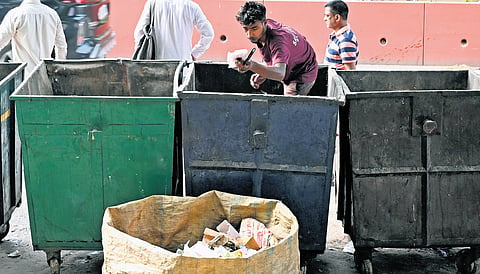

NEW DELHI: Delhi generates more than 12,000 tonnes of garbage every day; the people who keep the city functioning remain largely invisible. Long before the city roads witness movements of commuters, at dawn thousands of rag pickers and sanitation staff begin a different kind of journey. With tools like hooks, sacks, brooms, and carts, they navigate overflowing dumping grounds, narrow lanes and dustbins to collect, sort, and transport the city’s waste.
From formal and informal ragpickers and waste sorters to contractual sanitation workers employed by the Municipal Corporation of Delhi (MCD) and other civic agencies, these workers form the backbone of the capital’s waste management system. Yet their contribution continues to be overlooked, exposing the deep human cost behind the city’s sanitation infrastructure.
Delhi’s waste economy depends heavily on two broad categories of workers. The first consists of informal workers—primarily ragpickers, waste sorters, and recyclers—who recover recyclable materials from streets, garbage bins, markets, and landfill sites. Working without formal recognition or employment contracts, they earn a livelihood by selling recyclable plastic, paper, metal, and glass to scrap dealers.
The second group includes sanitation workers employed with the MCD. Nearly half of the total strength of Group D employees of the civic bodies have been working as contractual employees and are waiting for proper facilities, like regularisation, health benefits, safety equipment, utility centres near their working areas, etc.

The majority of sanitation workers in the MCD were engaged 10–20 years ago and even more, but they have yet to get permanent employment in the corporation. The unions representing these employees have said that few of them have got permanent letters after a change of guard in the civic agency, but the number is like a drop in the ocean. Besides this, there are many more issues which they want to be addressed to protect the interests of corporation employees.
There are nearly 75,000-80,000 sanitation workers in the MCD, out of which 30,000-35,000 are permanent employees while the remaining are on contract basis. Their key demand is regularisation of their service.
“Many of the sanitation workers have been working since the late 90s, and few were employed after 2000. Unfortunately many of them are at the stage of retirement without availing adequate facilities for their hard work,” said Rajender Mewati, leader of a union related to the civic body’s sanitation workers.
Mewati said that the current regime had promised to fulfil their demand; hence, jobs of hundreds of staff were regularised in the last few months. Employees have also been demanding arrears from 2006 from those whose services were regularised later, insurance facilities for them and cashless medical facilities, besides others.
Despite playing a crucial role in maintaining public hygiene and supporting recycling, both groups face precarious working conditions. Informal waste workers typically earn low and unpredictable incomes that fluctuate with the market price of recyclable materials. A day’s earnings often depend on how much recyclable waste they can collect, leaving many struggling to meet basic household expenses. Contractual sanitation workers, although employed through government contracts, frequently report delayed wage payments, lower salaries than permanent staff, and uncertainty surrounding contract renewals.
Safety remains one of the most pressing concerns across the sector. Waste workers routinely handle mixed garbage without adequate protective equipment, exposing themselves to hazardous chemicals, broken glass, biomedical waste, and sharp metal objects. Many work without gloves, masks, boots, or proper uniforms. Long-term exposure to dust, toxic fumes from landfill fires, and rotting waste contributes to respiratory illnesses, skin diseases, infections, and chronic health problems. The dangers become even more severe at Delhi’s landfill sites, where ragpickers climb unstable mountains of waste in search of recyclable material. The threat of fires, toxic gases, and waste slides remains constant.
Sanjay Gahlot, president of Delhi Safai Karamchari Aayog, said that challenges faced by waste workers are also deeply shaped by caste and gender. Sanitation work in the city has always been associated with marginalised caste communities, reinforcing centuries-old social hierarchies. Many sanitation workers continue to face stigma and discrimination despite performing essential public services.
He says that women constitute a significant share of Delhi’s informal waste workforce, particularly in waste sorting and recycling activities. However, they often receive lower incomes than men, carry the burden of unpaid domestic work alongside physically demanding labour, and face greater risks of harassment and exploitation. Access to sanitation facilities, childcare, maternity benefits, and safe working environments remains severely limited. For many women, the absence of formal recognition means exclusion from labour protections available to workers in the organised sector.
Manoj Kumar, an Ashok Nagar-based expert in this field, argues that creating a proper waste management system requires recognising waste workers as essential environmental service providers rather than treating them as expendable labour. Formal recognition, fair wages, timely salary payments, protective equipment, healthcare access, social security, and greater participation in policy decisions could significantly improve their working conditions.