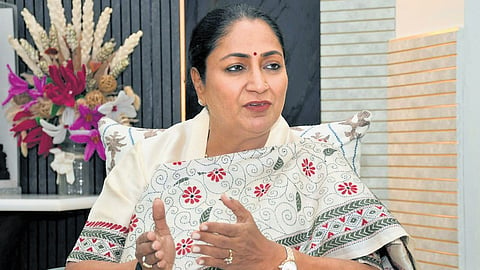

Upon completion of 17 months in office, Chief Minister Rekha Gupta says she is prioritising governance through implementation rather than mere announcements. Speaking with Anup Verma, she says the final report card of any government is written by the people, adding, “I can say with satisfaction that we have focused on changing the culture of governance in Delhi.” Excerpts:
The new EV Policy is being seen as a major step towards cleaner mobility. How do you see it transforming Delhi over the next five years?
Our vision is very simple: this policy is not just about electric vehicles; it is about giving Delhi a cleaner, healthier and more sustainable future. Every family wants to breathe cleaner air, spend less on transportation and live in a city that is future-ready.
This EV Policy provides incentives, builds charging infrastructure, supports manufacturers, encourages investment and creates new employment opportunities. It is a complete ecosystem, not just a subsidy scheme.
Over the next five years, we want Delhi to become India’s leading electric mobility city, where clean transport becomes part of everyday life. As more people shift to EVs, pollution levels will decline, fuel costs will come down and thousands of new jobs will be created.
Your government has set ambitious targets for electric vehicle adoption. What gives you the confidence that Delhi can emerge as India’s EV capital?
Delhi has always led the country in adopting new ideas, and I am confident that it will lead India’s electric mobility revolution as well. We are not simply asking people to buy EVs; we are creating the entire ecosystem needed to support them. Vehicular pollution is a major contributor to air pollution in Delhi. Every electric vehicle that replaces a conventional vehicle helps reduce emissions. As EV adoption increases, we will see cleaner air, reduced dependence on fossil fuels and a healthier environment for every family.
What are your plans to ensure charging stations are easily accessible to every Delhiite?
Charging infrastructure is the backbone of any successful EV policy. Today, Delhi already has around 9,000 charging points, and our target is to increase the number to nearly 32,000. We are working closely with DISCOMs, RWAs, commercial establishments and private partners to make them available across residential colonies, offices, markets, parking areas and public spaces. People should be able to access charging facilities easily wherever they travel in the city.
How will the incentives under the new EV Policy make electric vehicles more affordable for middle-class families and first-time buyers?
The policy offers purchase incentives, road tax exemptions, registration benefits and scrapping incentives. These benefits significantly reduce the initial cost of buying an EV. A transparent Direct Benefit Transfer system enables eligible beneficiaries to receive incentives directly, avoiding delays.
How do you expect the policy to benefit auto-rickshaw drivers, delivery partners, taxi operators and small businesses?
Commercial drivers are among the biggest beneficiaries of this policy because their livelihood depends on their vehicles. Lower running costs translate into higher monthly savings, making a real difference to household incomes over time. Along with financial incentives, we are strengthening charging infrastructure and creating support systems that make daily operations easier. We want to ensure that the transition improves the environment and the economic well-being of working families.
How will this policy create new employment opportunities in areas such as EV manufacturing, charging infrastructure, battery services and maintenance?
As EV adoption grows, there will be increasing demand for charging infrastructure, battery management, vehicle servicing, manufacturing, software solutions and skilled technicians. New investments will create thousands of employment opportunities, particularly for young people. We are also encouraging skill development to prepare mechanics and technicians for the future of mobility.
What role do you see Delhi playing in supporting the ‘Make in India’ and clean energy missions through this policy?
This policy fully aligns with the vision of Prime Minister Narendra Modi for Make in India, clean energy and sustainable development programmes. As demand for EVs increases, manufacturers, component suppliers and technology companies will find new opportunities to invest in Delhi. This will strengthen domestic manufacturing while reducing dependence on imports.
What is your message to people planning to buy their first EV but who still have concerns about charging, range or maintenance?
I would simply say: have confidence. Every new technology raises questions at first, but today’s EV technology is far more reliable than ever before. This transition is happening across the world, and Delhi is determined to lead it in India. I encourage every citizen to become a partner in building a cleaner and healthier Delhi.
What milestones should residents expect to see over the next one to three years as the policy is implemented?
If this policy achieves its full potential, I hope it will leave behind a legacy of a cleaner Delhi, a healthier generation and a model that other states can confidently adopt. Our vision is not just to reduce pollution today, but to build a future where every child grows up in a cleaner, greener and more sustainable Delhi.
City roads are frequently choked with traffic jams. How do you plan to address this issue?
There is no single solution to congestion. It requires better planning, smarter technology and stronger coordination among agencies. Our government is working on multiple fronts simultaneously. We are expanding electric public transport, encouraging greater use of shared mobility, improving last-mile connectivity, strengthening traffic management systems and accelerating infrastructure projects that remove major bottlenecks.
We are also working closely with the Delhi Traffic Police and other agencies to use technology for better traffic regulation and real-time monitoring. The EV Policy itself contributes to this effort. Removing encroachments is another important priority because roads are meant for movement, not obstruction. We have already initiated sustained drives to reclaim footpaths and public spaces, and this effort will continue with strict monitoring. A world-class capital cannot spend its future waiting at traffic signals.
Is the government planning to introduce a parking policy, given that parking has become a major issue?
Yes. For many years, parking was treated as an afterthought. As vehicle ownership increased, our cities did not expand at the same pace. The result is visible on almost every road today. Our approach is to make parking scientific, technology-driven and well regulated by better utilising existing spaces, improving digital management, curbing illegal parking and integrating parking facilities more closely with public transport. Future planning must also anticipate future mobility. Future parking infrastructure must be planned with electric mobility in mind. We cannot allow public roads to become permanent parking lots. Roads must primarily serve mobility.
How do you rate your government’s performance in your first year in office?
The final report card of any government is written by the people, not by the government itself. I can say with satisfaction that in our first year we have focused on changing the culture of governance in Delhi. For too long, governance became synonymous with announcements. Our effort has been to restore the culture of implementation.
Every department has been given measurable targets, timelines and accountability. We review progress regularly because public trust is built through delivery, not declarations. Whatever the problem, our approach has been consistent: identify the problem, fix responsibility and monitor execution.
I believe people can clearly see the difference in intent, work culture and administrative seriousness. We did not come to occupy office. We came to change outcomes. Our benchmark is not yesterday’s politics. Our benchmark is tomorrow’s Delhi.
The monsoon has arrived in Delhi. Every year, we see roads flooded and severe waterlogging. What preparations has your government made this time?
This year, planning started well before the monsoon season. A comprehensive Flood Control Order 2026 has been issued. Every identified waterlogging point in Delhi has been assigned a dedicated nodal officer with clear accountability. If waterlogging occurs, responsibility is fixed, not diffused. A 24x7 Central Flood Control Room has been operational since June 15. Major and minor drains have undergone time-bound desilting, mobile pumping units have been deployed for emergency response, and sector-level coordination committees are functioning across departments.
We have also identified vulnerable low-lying areas based on the lessons of the 2023 floods, with evacuation plans and emergency response systems already in place. Can any government promise that there will never be heavy rainfall? No. But what a government can promise is preparedness instead of panic, coordination instead of confusion and accountability instead of excuses.
Cleaning the Yamuna remains a major issue. What is your government’s approach?
The Yamuna is Delhi’s identity and our civilisational heritage. For decades, governments spoke about cleaning the Yamuna. Unfortunately, the gap between announcements and outcomes kept widening. Instead of treating Yamuna cleaning as a symbolic exercise, we are treating it as a mission with continuous monitoring.
Work is progressing simultaneously on desilting, drain management, sewage treatment, interception of untreated wastewater and inter-agency coordination.
This is a challenge that has accumulated over several decades. It cannot disappear in a few months. Every drain that is intercepted, every sewage treatment plant that becomes functional and every stretch of the river that is restored brings us one step closer to that goal.
The Yamuna does not need another slogan. It needs sustained work, scientific planning and political commitment. I assure the people of Delhi that our commitment is absolute because the future of Delhi and the future of the Yamuna are inseparable.
