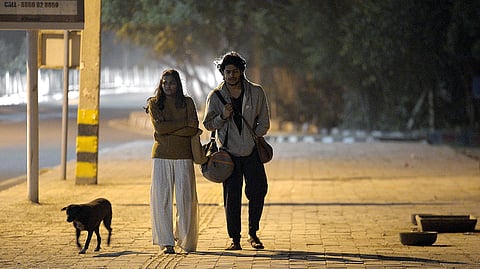

Delhi winters have a way of making people seek warmth—in blankets, cups of adrak chai, and in the people and places that slowly begin to feel like home. That longing for a home lies at the heart of FTII filmmaker Sanju Surendran's Khidki Gaav (titled If on a Winter's Night in English). Set in Khirki Village during the chilly days of December, the film follows a young couple from Kerala, Abhi (Roshan Abdul Rahoof) and Sarah (Bhanu Priyamvada), who arrive in Delhi hoping to build a home in a city that struggles to make space for them.
Khidki Gaav had its world premiere at the Busan International Film Festival in 2025, where it won the Hylife Vision Award, before making its India premiere at the International Film Festival of Kerala later that year. Recently screened in Delhi’s India International Centre this week, the film is currently in talks for a theatrical release this year-end, followed by its OTT debut.

Where the story began
The idea for the film began when a friend of Surendran told him about being evicted from his rented home in Khirki Village. As he began expanding that incident into a feature, other influences gradually found their way into the screenplay. One of them was Musafir (1957), a Hrishikesh Mukherjee film whose screenplay was co-written by Ritwik Ghatak, which uses a single house as a meeting point for different lives and stages of existence.
The English title, If on a Winter's Night, may recall Italo Calvino's celebrated novel If On a Winter’s Night a Traveller. The working title remains Khidki Gaav. "I couldn't find an apt translation for Khidki Gaav," he says. "Then we thought 'If on a Winter's Night' might be a good English title because the main event happens on a Christmas night in Delhi. It's very different from Italo Calvino's novel, but the title suited the atmosphere of the film."
Winter itself is indeed integral to the storytelling. "I would actually wait for winter to shoot this film. Winter is a very important character. It gives the whole texture to the film," he says.
Finding home
At its core, the film is not a conventional romance but about a relationship shaped by ambition, financial uncertainty and everyday survival. Abhi dreams of becoming an artist in a country where creative careers offer little financial certainty. Sarah, more practical, balances her academic ambitions with the expectations of her orthodox family while trying to hold their life together.
By placing the story within a live-in relationship between two migrants, Surendran found a way to heighten those pressures. "They're away from home. Everything is alien to them—the culture, the language, the food. So they become very dependent on each other. Even the smallest tension gets accelerated."
The film also explores the challenges of living away from home—being confined to a rented room with a difficult landlord, navigating financial anxiety and language barriers, all while doing the slow, often invisible work of creating a sense of belonging in an unfamiliar city.
"In art there is a concept of unheimat—homelessness. Good art can make you feel unsettled. I was thinking about that while making the film," he says.
Around the couple orbit two friends—Simon and Gopika (played by Raichel Samuel and Arathy K. B)—who are also trying to belong, often finding refuge in Abhi and Sarah's rented apartment. "A city becomes a good city if there are friends in it," says Surendran. "Home is also a place of like-minded people."
The film also sketches the simplicity of everyday life—Sarah leaving for work, Abhi sketching across Delhi, the couple cooking together, sharing a drink over Malayalam songs and slowly building friendships. It deliberately avoids sensationalising hardship.
"I generally don't like melodrama. Whatever comes organically from their lives, that's what I wanted to use. Through this march of non-dramatic elements arises the true power of the story. Otherwise you're forcing emotions that don't belong there," says Surendran.
A different Delhi
The film rarely shows Delhi through familiar or touristy landmarks, apart from brief glimpses of Hauz Khas Fort and Sarojini Nagar Market as Abhi and Sarah explore the city in their early days. Instead, National Award-winning cinematographer Manesh Madhavan's camera lingers on cramped rented rooms, neighbourhood lanes, the Metro and everyday gathering spots.
“There are beautiful monuments near Khirki Village, but we wanted to look at the city the way an immigrant couple would. The places important to them wouldn't be monuments; they would be shopping corners, hangout places, their homes and their friendships. These are the things that become important when you're trying to make a city your own," says the director.
Though Surendran has never lived for long periods in Delhi, the city has remained a recurring presence while transiting through film festivals during his days at FTII, visits to friends and time spent with his mentor, the late auteur Mani Kaul.
Eight years later
Khidki Gaav is Surendran's second feature after Aedan: Garden of Desire (2018). The eight-year gap, he says, reflects the realities of making independent cinema in India rather than artistic hesitation.
“It's very difficult to make independent films in India. There was another story I wanted to make, but that didn't happen," he says. "Then there was the flood, COVID-19, a web series that didn't materialise, producers backing out at the last minute." Eventually, Surendran and his collaborators decided to make the film themselves, pooling their resources and travelling to Delhi together.
He is currently developing his next feature, Kothiyan (Fishers of Men), adapted from a script by Malayalam novelist S. Hareesh after the project received support at the Hong Kong–Asia Film Financing Forum (HAF). While encouraged by the growing international recognition for Indian independent cinema, he believes the ecosystem remains fragile.
"We don't have enough production avenues," he says. "Countries in Europe have public funding systems for cinema. We don't. Distribution is another huge challenge. Even when independent films are made, getting them into theatres is incredibly difficult."