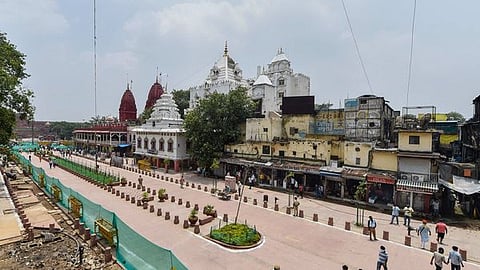

NEW DELHI: The governmernt is trying to redevelop a 376-year-old marketplace that has outlived empires, survived the making of modern India, and remained the beating heart of Old Delhi through every chapter of its history.
Barely 1,400 yards long, Chandni Chowk stretches from the Red Fort—whose ramparts become the nation’s stage every Independence Day as the Prime Minister addresses the country—to the 17th-century Fatehpuri Mosque. Few streets in India have witnessed so much history, and fewer still continue to carry lakhs of people daily.
When Mughal emperor Shah Jahan founded Shahjahanabad in 1650, Chandni Chowk was planned as the commercial heart of his new capital. The avenue was designed by his favourite daughter, Jahanara Begum, who imagined a broad boulevard with a canal flowing through its centre.
The water collected in a square pool that reflected the moonlight, giving the market its enduring name—Chandni Chowk, the Moonlight Square. The centuries changed almost everything except the street’s purpose.
The charm waned. The havelis slowly became shops, warehouses, offices and hotels. Chandni Chowk grew into one of India’s largest wholesale and retail markets, famous for its textiles, jewellery, spices, old eateries and Paranthe Wali Gali. Every day, lakhs of people come for business, shopping, religious visits and tourism.
With the crowds came familiar problems. Narrow lanes struggle to accommodate pedestrians, cycle rickshaws and delivery vehicles. Parking is scarce. Public conveniences have never kept pace with the growing number of visitors. The old city remains full of life, but also of congestion. Earlier attempts to bring order to its streets never fully succeeded.
That is the challenge now before the government. CM Rekha Gupta began with a symbolic decision: the Shahjahanabad Redevelopment Corporation, created to conserve and redevelop Old Delhi, was renamed the Indraprastha Virasat Punarvikas Nigam.
CM asks offcials to establish control room to help Chandni Chowk visitors
Officials reminded the meeting that Old Delhi covers just 7.12 square kilometres, yet contains one UNESCO World Heritage Site, 10 nationally protected monuments, 10 state-protected monuments and more than 700 locally protected heritage sites.
It is one of the country’s richest historic precincts, but also one of its busiest. The redevelopment, officials said, is essential not only for conserving its heritage but also for giving fresh momentum to trade and tourism while reinforcing Old Delhi’s historic identity.
The CM told officials that the development of Old Delhi should not be confined to physical infrastructure alone. Heritage conservation, tourism promotion, economic activity, civic amenities and environmental balance, she said, must move together through an integrated approach. The first priority would be Chandni Chowk.
Gupta directed officials to expedite the market’s redevelopment while ensuring that its design continues to reflect its historical identity, traditional character and cultural significance. Officials were asked to build modern public toilet complexes, expand civic amenities and develop organised parking facilities to serve the lakhs of people who pass through Chandni Chowk every day.
While reviewing the restoration of the historic Town Hall, she instructed officials to create a major entrance and exit on the Chandni Chowk side so that the landmark can emerge as a major heritage and tourist destination.
She also directed that a dedicated tourist assistance and control room be established in the market to provide information, guidance and prompt help to visitors arriving from across India and abroad.
Gupta asked officials to prepare a detailed blueprint for the integrated development of the Hanuman Temple at Yamuna Bazaar and the area behind it. She also directed them to prepare a redevelopment and beautification plan for the Jama Masjid area and Syama Prasad Mookherjee Marg outside the Old Delhi Railway Station.
Chandni Chowk may be a heritage district, but it is also a living marketplace. Gupta said the market had evolved alongside the area itself, and restoring its past glory would require keeping the interests of its markets, traders and shopkeepers at the forefront.
Today, Chandni Chowk is preparing for another transformation, to make one of India’s oldest marketplaces cleaner, easier to navigate and better equipped for the future.
