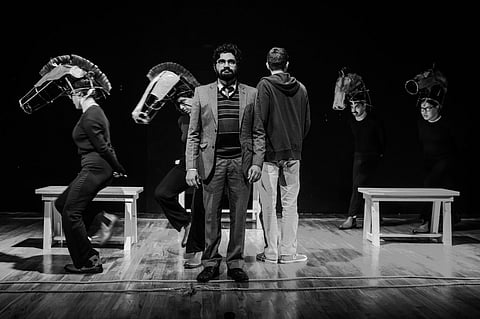

Theatre director and actor Sukrit Mahajan first encountered English playwright Peter Shaffer's Tony Award-winning play Equus as a college student in 2017. This month, he is bringing his reimagining of the psychological drama to Delhi—a city that is both his hometown and the latest stop in the play's journey across India.
Written in 1973, Equus was inspired by a real-life incident in Northern England. The play follows Martin Dysart, a psychiatrist tasked with treating Alan Strang, a teenager obsessed with horses and who has blinded several of them with a metal spike. As Dysart delves deeper into Alan's religious, emotional and sexual fixations, he finds himself confronting his own inner turmoil and the suffocation of his monotonous life.
For someone with little experience of live performance, Mahajan says Shaffer's intense exploration of faith, sexuality and obsession was an overwhelming experience for him. “Technically, this shouldn’t be anyone’s first play to perform; it’s visually very strong and thematically very powerful,” says the 27-year-old director. “When such a play becomes your first experience into the world of theatre, that has to leave a mark.”

Equus marked Mahajan's first project as a professional director and coincided with the launch of his theatre company, Playhouse, in 2024. On July 26, it comes to Delhi for the first time after Mumbai, Bengaluru, Pune and Ahmedabad. The 120-minute production features a seven-member ensemble, with Meghna Manglani as assistant director, Prerana overseeing the lighting design, and Playhouse co-founder Durga Venkatesan as creative producer.
Despite encountering Equus nearly a decade ago, Mahajan credits it as the work that has shaped him the most. “As an actor, you tend to get really involved in the emotions, the character and everything. With this play, my entire life changed. I decided that this is what I want to do.”
Equus has been staged at London's National Theatre and later on Broadway with actors such as Anthony Hopkins, Leonard Nimoy, Daniel Radcliffe and Richard Griffiths. Taking on such a celebrated work as his directorial debut was an ambitious move, especially alongside the launch of his theatre company. “I read many plays, but I never came across anything as powerful or theatrical as Equus,” he says. “When I started my own company, I wanted the production to be something big and elaborate.”
Despite the play's history and legacy, Mahajan approached the production with little pressure. “When you're directing for the first time, you can either put a lot of pressure on yourself to get everything right or simply do what you want. I chose the second approach. I wanted to enjoy the process.”
The churn of the mind
In the play, Dysart attempts to understand Alan's fascination with horses, through which Shaffer explores themes of normalcy, worship and desire. Despite being written over 50 years ago, the play's concerns remain strikingly contemporary.
“This play for me is about the exploration of the human mind—its complexities and the extremes to which it can go. Humans don’t change. That will remain constant no matter what,” says Mahajan.
What has changed, he argues, is the way audiences engage with themes such as mental health, sexuality and identity. “There are more and more people in India becoming aware of these issues,” he says. “People now have a broader lens through which to look at the play rather than just seeing it as the story of a boy who committed a crime.”
The shadow self
Mahajan’s version of Equus is simply a “reimagining” rather than an adaptation, remaining faithful to Shaffer's original text and setting. His production of Equus is presented by arrangement with Concord Theatricals Ltd. on behalf of Samuel French Ltd.
“I didn’t want to adapt it to an Indian context. I wanted to create a different world inside the four walls of the theatre—one that doesn’t exist outside it,” he says. “We haven’t changed the context or the story. We’ve simply put our own lens on it.”
Adding another layer to the storytelling is the exploration of Carl Jung's concept of the Shadow Self—the hidden, often suppressed parts of one's personality—which Mahajan explores through shadow theatre to bring the inner worlds of Dysart and Alan to life. “Once we started reading the play through this lens, everything really started falling into place,” he says. “The play, which on the surface is about Alan and Dysart, suddenly became about every single character and why they behave the way they do.”
To translate that idea on stage, the production uses silhouettes and projections to represent the inner lives of its characters. Mahajan says the device allowed the company to create “two different worlds”—the shadow self and the projection self.
Discovering nuances
Since premiering in 2024, the production has continued to evolve. Having travelled to multiple cities, Mahajan says the actors have also grown into their roles. “The play really settles into the actors’ bodies over time,” he says. “They stop consciously thinking about the character and begin simply being the character.”
The play continues to reveal new meanings to him. “Every time I return to the script, I find something different,” he says. “That’s the wonderful thing about great art. Every time you revisit it, it gives you something new.”
Equus will be staged at the Little Theatre Group Auditorium, Mandi House, on July 26 at 5 pm and 8 pm. Tickets are available on BookMyShow.