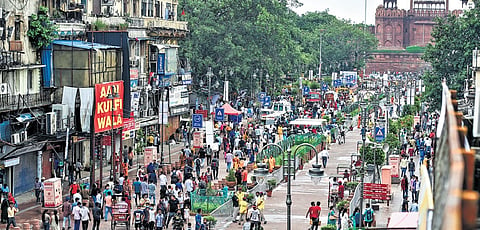

In the densely populated lanes of Shahjahanabad, where the call of vendors echoes with temple bells and azaans and the hum of everyday life, the past is not a memory; it is a lived reality. Historical landmarks like Jama Masjid and Red Fort continue to anchor both space and sentiment, shaping how the city breathes and moves.
Yet, even as historians, architects and long-time residents argue for a “people-first” renewal that preserves this layered heritage, the government’s most visible intervention in recent times has been symbolic—renaming the Shahjahanabad Redevelopment Corporation (SRDC) as the Indraprastha Heritage Redevelopment Corporation.
The move, announced last week, four months after Chief Minister Rekha Gupta took charge as SRDC chairperson, has sparked a wider debate: is the old city being reimagined or merely renamed while its complex realities remain untouched?
Old Delhi has charmed rulers, commoners and travellers alike for centuries. It has also consumed the policy bandwidth of successive governments in the city, who have proposed one plan after another to redevelop the city and recreate its past magic.
The charm and romance of Old Delhi defy the logic of multiple attempts at urban planning across decades. As the centuries of Delhi’s history become a topic of a historian’s memory, a conservationist’s heart and a bureaucrat’s brain again, the people of the city are asking if the stubborn temptation of the old city will stay preserved in its revamped continuity.

More than a historic precinct
“Shahjahanabad feels like a living conversation—vivid, unpredictable, overwhelming, yet deeply absorbing. Amid its chaos and crowds, there are pauses: spaces to gather, listen and be heard, layered with sounds of bells, greetings, honkings and birds. Its landmarks Jama Masjid, Lal Qila and Sis Ganj Sahib anchor you through winding lanes, offering direction and a tangible sense of history,” said Anisha Shekhar Mukherji, author, conservation architect and visiting faculty member at the School of Planning and Architecture.
She captures the essence of the area as a method of seeing, a way of understanding cities as lived experiences rather than engineered outcomes. “In an age when urbanisation is presented as both inevitable and desirable, and when cities are growing rapidly in size and number, it is worth pausing to reflect on how cities should be made. Shahjahanbad, I suggest, offers valuable lessons for such reflection,” she added.
Mukherji is currently working on a personal project titled “ShaharDelhi6”, an extension of her research on the Red Fort. At its core lies a often overlooked premise: listen before you plan. In a neighbourhood where every lane carries a story and every facade reflects layered histories, her work attempts to foreground voices that are often sidelined in formal planning processes.
She mentioned a small library that has a Victorian way of design—Shahwaliullah Library. A proposal to reopen the nearby MCD school so that the library could be expanded proved futile. According to her, redevelopment must begin with a shift in priorities by adopting a “people-first” approach that works from the micro to the macro level.
Only then, she said, can a meaningful redevelopment plan be prepared. For Mukherji, the future of Shahjahanabad lies not in grand master plans but in attentive, incremental interventions rooted in community needs. “This may sound utopian. But, as Kevin Lynch cautions in Good City Form, ‘Without some sense of better, any action is perverse.
When values lie unexamined, they are dangerous. Imagining alternatives is thus not indulgent, but essential. If we are serious about answering the question about the purpose of cities and how they ought to be made, we must begin by re-examining the values embedded in our urban form. Identifying the characteristic attributes in such urban form can work as both markers and tools to help us do so.”
Between renewal and redevelopment
That question of what kind of city Shahjahanabad should become has acquired renewed urgency in light of recent administrative changes. For many scholars and residents, however, the renaming of institutions does little to address the deeper, structural challenges facing the area.
Shama Mitra Chenoy, professor of history at Shivaji College, University of Delhi, traces her relationship with the city through memory. Speaking at a recent session “Life and Loss of Shahjahanbad”, she revisited her childhood experiences in Katra Neel. Memories that, she argued, are rapidly fading.
“First thing, the name shouldn’t be changed from Shahjahanabad to Indraprastha. Secondly, like-minded people need to sit and work on the ample complexities. There are several agencies which need to coordinate. There should be no malls in the area. As a child, I remember open spaces while moving from Katra Neel to Hotel Mewa and to the Town Hall. Now the lanes are full of wares packed and exported along with hundreds of unregulated shops.”
Her perspective focuses on the erosion of public space in the old city, a process driven as much by unregulated commercial activity as by policy neglect. The disappearance of open spaces, once integral to the social life of Shahjahanabad, is seen not merely as a physical loss but as a cultural one, she said.
For Swapna Liddle, historian, author and heritage conservator, the problem lies in the very framing of redevelopment. “The concept of redevelopment is misguided. It has gone in the wrong direction. The courtyard houses, small houses without any gaps, narrow lanes, bazaars, etc. are the identification of Old Delhi. It is an asset, and that is how we should look at it. Historic cities have turned around by working on the beautification.”
Liddle argued that Shahjahanabad should be treated not as a site for transformation, but as a living historic entity requiring careful stewardship. “I believe that the bye-laws for Shahjahanabad have to be different. That area has to be seen with a different approach. Old Delhi is a living historic place; it is not a monument.
That historical fabric of this part of the capital has to be conserved, considering the needs of the public. I would like to point out that instead of allowing such a huge fancy mall to be built in Old Delhi, the government could have helped the Old Bazaars. By bringing up a mall there, you set up a competition for people sitting in markets like Dariba and Khari Baoli. This is not how we protect our history.”
Questions of identity, what Shahjahanabad is, and what it should be called also form a critical part of the debate. Narayani Gupta, urban historian and former faculty at Jamia Millia Islamia, criticised the renaming of Shahjahanabad as Indraprastha, calling it historically inaccurate. “You could call Purana Qila ‘Indraprastha’, or even Jamnapar, because there is at least some historical association. But what is the relation here? It is like calling London—Paris,” she said. Gupta added that she prefers to call the area simply “Dilli”, its original name, rather than Old Delhi or a walled city. “This place has its own significance. It cannot simply be redeveloped,” she said.
Meanwhile K T Ravindran, retired urban designer, former dean at the School of Planning and Architecture (SPA) and also the former chairman of the Urban Art Commission, offered a more structural critique, focusing on the processes and priorities that have shaped interventions in the area over the decades. He also said that “redevelopment” is a wrong word, it should be “renewal”. Ravindran added,
“The old character of the area has to be preserved. Old Delhi had enjoyed good reputation, but post-independence, cold storages, godowns and chemical trades led to over-commercialisation, and this is what impacted the physical and social urban fabric of Old Delhi.” He pointed to a series of missteps—conceptual and operational.
“The government needs to think about its social and historical phenomena and improve its walkability. What the government did with Chandni Chowk is a bad example. Chandni Chowk was named because the moonlight used to reflect in the fountain water in the middle of the market, but sewage lines were put up there. This kind of intervention was wrong,” he added.
For Ravindran, the issue is not the absence of plans but the lack of coherence and continuity in their execution. He recalled earlier efforts to approach the city in a more granular, ward-based manner. “In 2007, when I was the dean at SPA, I had sent an official proposal to develop Old Delhi ward by ward; originally, each ward was to be studied, MCD officials were to be involved, and projects for each ward were to be identified. Following the proposal, they called for tenders, but at a very small cost, hence nothing happened.”
His account pointed to a recurring pattern: ambitious proposals undermined by inadequate resources, fragmented authority and shifting political priorities. Despite decades of neglect, Ravindran insisted that the city’s underlying structure remained resilient. “Old Delhi has a robust design structure with open spaces linking certain places. Even after 70 years of abuse, it has its own identity.
What lacks is the larger vision. A lot of authorities need to coordinate. When we allowed it to deteriorate for so long, we can definitely allow it to get a renewal. It is just that Old Delhi has a maddening business interest. A small 3 by 5 feet shop in Old Delhi is profiting more than any store in CP.”
Echoing these concerns, historian Irfan Habib also raised a fundamental question about intent. “What does the government mean by redevelopment? Are they going to bring down the old heritage buildings and residential areas? Instead, we need to protect the buildings. Old Delhi has a lot of structures which need to be preserved instead.”
Coordination among agencies emerged as a major hurdle, compounded by issues of enforcement and maintenance. A former PWD chief, speaking on condition of anonymity, described the difficulties of implementing redevelopment plans in a context marked by overlapping jurisdictions and limited authority. According to him, municipal bodies initially struggled to execute projects, leading to the PWD being tasked with the responsibility only to find itself constrained by similar limitations.
The redevelopment of Chandni Chowk, he noted, illustrated this gap between planning and upkeep.
Essence must not fade away
Arshad Ali Fehmi, a resident of Deen Duniya House in Chhatta Sheikh Mangloo Lane, said that it is a matter of balance. “The redevelopment must be treated as a heritage conservation mission. As a local, I firmly believe that development and preservation can, and must, go hand in hand.” His perspective bridges the often polarised positions of conservation and development, arguing instead for an integrated approach.
Fehmi outlined priorities that balance everyday civic needs with long-term conservation. Heritage facades, historic buildings, uniform signage, traditional street lighting and materials that complement the area’s architectural character should form an integral part of the project. Traffic congestion and pollution, he added, also demand urgent attention.
Echoing the sentiment, Zarina Rehman, another resident, said the city’s greatest strength lies in its cultural legacy, and development should make Old Delhi cleaner and safer without erasing its historic identity.
Shahjahanabad, or Old Delhi, whatever nomenclature one may want to adopt, is a living heritage city with centuries of history, culture, architecture and traditions. A policy maker cannot afford to ignore its rich history for the sake of confusing models of urbanisation and redevelopment. Locals believe what Fehmi said: “Modern interventions should be sensitive to the original urban character rather than replacing it.” After all, people who have lived in Shahjahanabad for generations understand it the best.