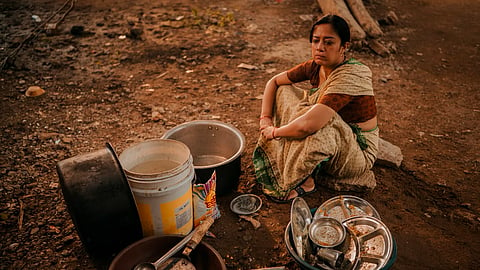

A new film, It's Only 47°C, seeks to make audiences feel the exhaustion, isolation and the resilience of those living through extreme heat. "We wanted viewers to sit with these characters, experience their stillness and endurance, and ultimately give people who are often ignored a face and a voice," says its director Tej Sisodia.
The film follows the lives of people often overlooked in urban spaces, including traffic constables, rickshaw pullers and roadside vendors. Sharib Hashmi, who plays the lead role of Lakshman Chaubey, a traffic constable, is seen bearing the brunt of a system that fails to curb the effects of climate change.
"The frontline are the invisible engines that keep our chaotic systems moving even at peak heat, while the more privileged remain insulated behind air conditioners," he says.

Class divide
According to Sisodia, the film deliberately shifts the conversation on climate change from abstract statistics to lived human experiences, and perhaps that's why it doesn't say which city the protagonist belongs to. "This is a story about suffocation, survival and the silent suffering of our most vulnerable communities in the face of global warming, policy neglect and systemic inequities," he says.
Climate action only becomes meaningful when climate is translated into culture, says the film’s producer Harish Borah, who believes that storytelling is a powerful tool to mitigate the unequal burden of extreme heat in Indian cities.
A small girl sitting in an air-conditioned car stares at Chaubey, the traffic constable struggling in the heat outside. This five-second scene brings to the fore the class divide — the central theme of the film — more than all the dialogues combined. The film portrays how a section of society is out in the open to make ends meet while the other half has the privilege to be nonchalant about it.
The camera follows those who have no choice but to step out into the unforgiving heat. The sweat-soaked clothes of the cop, the house help, the rickshaw puller, and other frontline workers, their parched faces, and their brief moments of respite in the shade, put the spotlight on their existential struggles to survive in an increasingly warming world.
"Zyada dhoop mein mat rehna", is a luxury some can't afford. The film delves into the normalisation of temperatures that have become a routine part of life for millions.
Lived experiences
Drawing from his childhood in a small village in north India, Sisodia says his lived experiences shaped his understanding of the stark contrasts between rural and urban life, inspiring stories rooted in everyday realities.
Having previously directed Raakh, which was screened at multiple film festivals, Munna Ka Bachpan, which premiered on JioStar, and Avni, which had its world premiere at the 25th Santa Fe Film Festival in 2025, Sisodia's latest work turns its lens on India's rising temperatures and the invisible workforce that keeps cities functioning.
It's Only 47°C premiered at Mumbai Climate Week 2026. It is now touring festivals globally while supporting advocacy through screenings with students, stakeholders and public institutions. It is currently available for viewing on Pocket Films' YouTube channel.
"This film is born out of my personal observations," Sisodia says. "It reflects the brutal summers I witnessed growing up in north India, where the heat doesn't just scorch the land—it scorches lives." His father, who is a farmer, has experienced the harsh consequences of heat with dry land, less rain, debts and crop loss. The film shares the saga of a helpless farmer, triggering a conversation on deforestation, concrete jungles and more. During the conversation, a woman who runs a roadside stall, a labourer, and the farmer talk about the differences in their experiences – the film thus shows that climate change isn't endured equally.
The film advocates inclusive heat action plans for vulnerable workers. Harish and Sisodia found a great partnership first with Naseeruddin Shah, and then with Anushka Shah from Civic Studios – who came in as co-producers for the film. Borah says they wanted people “to feel the human reality behind rising temperatures. Cinema has an important role in making climate change more personal and accessible".
It's Only 47°C is an outcome of Tej and Borah's friendship and was born out of long conversations. The film also features a poem by Swanand Kirkire anchoring its emotional narrative.
Climate change is often measured in degrees, but its deepest impact is felt in human lives. As the film ends, we see the tired constable, soaked in sweat, sit down on the streets. For him, it's not a respite; it's not a battle won—it's just the way his life is.