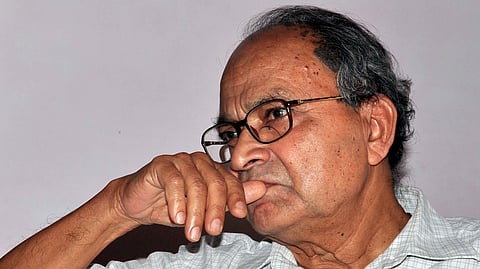

Anand says Stolen Gods (Niyogi Books), the English translation of his Malayalam novel Apaharikkapetta Daivakal (2001), is not simply a story about philosophy or religion, but about life itself—particularly the lives that often remain invisible.
Translated by his daughter, Chetana Sachidanandan, a scientist and professor at the CSIR-Institute of Genomics and Integrative Biology in Delhi, Stolen Gods follows Ganeshan and Naseema, a couple whose lives are shattered after the loss of their only son. As they struggle with grief, the search for answers leads them into a larger world of missing children, migrants, violence and injustice, where personal tragedy begins to mirror the fractures of society.
Through its characters and their experiences, the novel raises questions about faith, philosophy and society. Speaking about the inspiration behind the book, the acclaimed Malayalam writer points to his experiences as a civil engineer, which took him to different parts of the country, and played a significant role in shaping his writing. He says his "exposure to the life around" has been the inspiration behind all his works, and Stolen Gods is "no exception".
Sachidanandan also notes that the novel draws from a mix of real news reports, incidents the author witnessed or heard about, and imagination. For instance, an acknowledgement note at the end of the book refers to American writer Isabel Fonseca's Bury Me Standing, which recounts an instance of an elderly Romani woman seeking help to find her son who had fled to the city with only a faded piece of paper. One of the novel's chapters, which tells a similar story, is inspired by Fonseca’s account.
Interestingly, the city where the novel is set is never named. Anand explains that leaving the setting unnamed broadens the novel's scope and underscores that the events — of displacement and violence — it depicts are not limited to one place but could unfold anywhere in the country.

The translation challenge
For Sachidanandan, translating Stolen Gods is a way of bringing Anand's writing to readers beyond Malayalam.
"The main impetus for doing translations of his work was because his work, although written in Malayalam, is not really meant for a Malayali audience," she highlights. "It tells stories of pan-India, even sometimes universal ideas of justice, truth, suffering and power. I felt that it needs to get to a wider audience."
Having previously translated his Malayalam novel Samharathinte Pusthakam (2005) into English as The Book of Destruction (2012) — it was shortlisted for the DSC Prize for South Asian Literature in 2014 — Sachidanandan says Stolen Gods offered a very different translation experience. While the earlier work revolved more around questions of politics and power, she describes Stolen Gods as a novel centred on grief and discovery.
"It is actually a father's quest to understand his son," she says.
What were the challenges of translating the novel? Sachidanandan says the philosophical passages and poems demanded particular care. "There are dense paragraphs with philosophical discussion [in the book]," she says. "You need to get the ideas correct, but still the language should flow properly."
The poems in the book — written by Ganeshan's son, Aman — posed another challenge.
"When you're translating a poem, prose and poem work differently," she says. "You need to keep the idea of the author, but as the language changes, the rhythm and the music of the language changes. So you have to adapt it to English. Hence, this process was interesting."
Sachidanandan also hints at the novel's exploration of migration, justice and power. "This book is a reflection on how cities form and how migrant populations and resident populations interact," she tells TMS. "Power, politics, justice and powerlessness are all part of human experience, and in a city they come into play a lot."
Bridging literary worlds
She also sees translation as a vital bridge to new readers, saying it helps India's literature reach the country's vast English-reading audience across generations. While she does not believe readership in Indian languages has necessarily declined, she notes that translations make it possible for readers across states to discover stories they may otherwise never encounter.
Describing Anand's writing, Sachidanandan says it stands apart because it is shaped by experiences across India rather than being confined to Kerala.
"His work is paradigm-shifting in Malayalam literature," she remarks. "The ideas are really heavy. These are not light-hearted books to read. They are extremely thoughtful and disturbing works."
She hopes the book encourages readers to confront realities that often remain outside their everyday lives.
"It will not make you feel good after reading it," she says, adding, "But it will shake you up. As a person who lives in a city and hardly ever sees the world beyond the perimeter of one’s own life, it is an experience for any urban reader. It is something that serious readers should pick up and try."