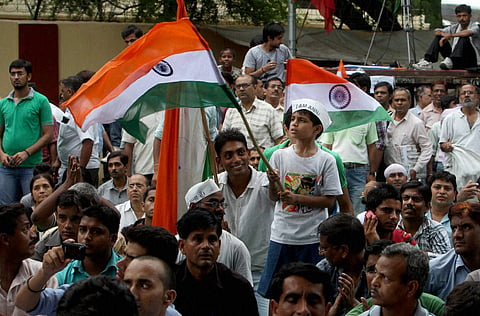

A few metres away from the giant sundials built by Maharaja Jai Singh II in 1724, it’s the placards that define Jantar Mantar. For decades, the place in the heart of the city has served as India’s loudest stage of dissent where citizens assemble hoping that the power will listen. However, Jantar Mantar was never designed to be a protest site. It became one through a series of events that caught the national attention.
Lately, the fire faded out, and it was all silent until it came alive again after years of decline. It has hosted many key protests in the past, demonstrations by students, farmers and job aspirants. In recent years, restrictions reduced its role but, the space is active again, with the Cockroach Janta Party (CJP) and Sonam Wangchuk staging a protest for the past month.
What’s interesting is the urban GenZ claiming the space with curiosity discovering Jantar Mantar as an urban landscape. The site’s revival highlights how Jantar Mantar continues to be an important space for public protest and democratic expression in the city.
A fading protest site
Jantar Mantar’s resurgence is significant precisely because it had, for a time, receded from public life. Once the epicentre of some of India’s most defining protests, the site had seen its relevance diminish amid increasing restrictions. Delhi’s protest geography has undergone a steady transformation over the decades. In the decades before the 1990s, the Boat Club near India Gate was the city’s primary site of dissent.
But in 1993, citing security concerns and the difficulty of managing such large gatherings near Parliament and Rashtrapati Bhavan, authorities banned protests at Boat Club. What followed was a shift to Jantar Mantar, a smaller, more contained site. Visible enough to be heard, yet easier to regulate.
However, on October 5, 2017, the National Green Tribunal ordered a complete halt to protests at Jantar Mantar, banning gatherings and directing authorities to shift protesters to Ramlila Maidan. For nearly nine months, the site fell silent until the Supreme Court intervened in July 2018, restoring protests but under regulated conditions.
Echoes of past protests
Jantar Mantar’s current revival cannot be understood without recalling its recent past. Although Jantar Mantar had become a protest venue in the 1990s, 2011 was its defining moment that transformed the site into a national symbol. A political party was formed after the anti-corruption activist Anna Hazare began his fast demanding the Jan Lokpal Bill.

The movement changed how India viewed Jantar Mantar, no longer simply as a designated protest location but as a physical embodiment of citizens seeking accountability. The years that followed saw demonstrations demanding justice for the Nirbhaya gang-rape victim, the pension movement, campaigns against environmental degradation, protests by students and several other issues.
In a limited way in2023, the site became the stage for a high-profile protest by India’s top wrestlers Vinesh Phogat, Sakshi Malik and Bajrang Punia, who accused the then Wrestling Federation of India chief Brij Bhushan Sharan Singh of sexual harassment. What began as a sit-in in January escalated into a month-long protest that drew national attention.
On May 28, 2023, the day the new Parliament building was inaugurated, the protest ended dramatically, with Delhi Police clearing the site and detaining protesters attempting to march towards Parliament. The images from that day – tents dismantled, athletes detained – left a lasting impression, reinforcing perceptions of shrinking space for dissent.
The GenZ movement
What distinguishes the present mobilisation of youth at Jantar Mantar is its unmistakable Gen Z character. The protest did not begin at the site; it began online.
Instagram reels, X threads and WhatsApp forwards carried snippets of speeches, hunger strike updates and calls for solidarity. Within days, the movement gained traction, its reach expanding far beyond the city. Students from Delhi University, Jamia Millia Islamia, JNU and universities across states began arriving in groups, some coordinated through digital networks, others simply responding to what they had seen online.
For the Gen Z, the boundary between digital and physical protest is almost non-existent. Jantar Mantar becomes an extension of their online presence, a place where hashtags take shape as bodies, voices and collective action. Gen Z curious about CJP movement has hit the ground, even if in the small corner of Delhi.
“We saw it everywhere online, but being here feels different; it’s like our posts have come alive. Also, don’t think that you alone can change anything or not. You as a whole individual are enough. Imagine if everyone starts thinking like that,” said a DU student. “Social media gets people together, but the street is where change begins, and we gather here every day just to see the change some day,” said a Jamia student.
Aditya Nigam, retired professor at the Centre for the Study of Developing Societies, believes that the reason why the movement belied false expectations and caught the imagination of an ever-increasing number of youth is because this is probably the first time a movement has emerged that is led and organised by the youth themselves.
He said, “I should underline that these digitally connected young people who have been turning up in Jantar Mantar are no elite kids. They are the worst affected by paper leaks because these exams are their only hope. They don’t have connections.”
Education became the rallying point
While education has long been a site of contestation, the past few years have seen a sharp escalation in public anger. Repeated paper leaks, delayed results, opaque processes and rising anxieties around jobs have converged to create a sense of collective frustration, particularly among young people.
For many, this protest marks a tipping point. It is not tied to a single policy or institution but reflects a broader unease about the future. Dr Amir Ali, assistant professor at the Centre for Political Studies (CPS), JNU, situated this shift in a wider context: “Back in the 1990s there was a wider and more general level of apathy and indifference towards politics especially among youngsters.
Today young people seem to be aware of politics in a more intense sort of way, but this intensity does not find any effective channel of political articulation and communication. As far as today’s youngsters and their concerns, they seem to be motivated by the immediate things that touch lives like education, flaws in the examination sy tem and lack of employment opportunities.”
Talking about the difference of protests during Anna Hazare’s time and this protest, Yogender Yadav, founder of Swaraj India, said, “Anna movement was also anti-establishment and anti-government, but there was dialogue. Now there hasn’t been any conversation, but instead an attempt to malign the agitation. If you remember, when Anna was at Jantar Mantar, they tried to arrest him and take him to Tihar Jail; within a few hours, he had to be released, and that is when the Ramlila Maidan thing started. That moment gave a flip to the movement.”
The present moment
For 30 days straight, without a break, the site has seen a steady stream of participants in support of the CJP. Hunger strikers lie under makeshift tents. Volunteers distribute ORS, biscuits and water. A small, improvised clinic offers basic care. Free libraries have appeared on pavements and small stalls which invite you to write letters to the education minister. Conversations spill from placards to pavements to phone screens.
What sets this protest apart is not just its longevity but also its breadth. Students, teachers, professionals, activists and families–people across age groups have converged around a shared concern: the state of education and the deepening crisis of trust in public institutions, particularly around examinations and accountability.
Veteran education activist and retired St Stephen’s College professor Nandita Narain sees it as a turning point: “The CJP protest has reclaimed the space for peaceful protest. The hunger strike by Sonam Wangchuk and 20+ students touched an emotional chord across the country. In the last few days especially, support from all sections has been pouring in on social media, and Jantar Mantar has been bursting with life. The sheer diversity of backgrounds of participants has been overwhelming! By not entering into a dialogue with the protestors and, instead, shifting Sonam Wangchuk to the hospital, they will further galvanise support for the movement.”
Reclaiming a space
Jantar Mantar is now a living, breathing space of activity, one that has reclaimed its place in Delhi’s political imagination and continued with the tradition it has stood for for generations.
Retired IAS officer Ramesh Negi, who has served in the Delhi government for several years, said, “Jantar Mantar as a tourist site may have become dead, but not as a site of protest. I believe that it was the wisdom of the government to think of the prime location for people to hold protests. This place is in the heart of the city, and that is what matters, and its importance lies there. It has higher visibility; it is convenient in terms of transportation and even for the authorities to keep a vigil. It was indeed a pragmatic decision to allow this place to turn into a protest site.”
One of the supporters at the protest site, Vibha Sangwan, a teacher in a private school in Malviya Nagar, echoed similar opinions and said, “Jantar Mantar is not just a place; it’s a voice. For people like us, it represents the last accessible space where ordinary citizens can come and be heard without fear. Over the years, Jantar Mantar has carried the weight of countless movements, and standing here feels like being part of that history.”
However, Abha Dev Habib, Democratic Teachers’ Front and a Delhi University faculty member said, “There were times when we were allowed to march from Barakhamba to Mandi House and then to Jantar Mantar. In 2016, when there was an attack on JNU, more than 12,000 people had gathered for a protest march from Barakhamba Road to Jantar Mantar. However, I feel Jantar Mantar now is like throwing protestors in an alley which is not visible to the outside world.”
Yet, the site remains powerful in its quiet way. When people gather at Jantar Mantar, they are not just protesting an issue, they assert “rights to speak, to dissent and to demand accountability in a democracy”. The endurance that the space holds for people of Delhi has acquired vigor again for another generation.
2011
Anna Hazare’s anti-corruption movement
Social activist Anna Hazare began a hunger strike on April 5, 2011, demanding the Jan Lokpal Bill. It snowballed into a nationwide anti-corruption movement.
2012
Nirbhaya justice protests
Following the brutal Delhi gang-rape in 2012, Jantar Mantar became a key site for candlelight vigils and demonstrations demanding justice and stricter laws for violence against women.
2017
40-day long Tamil Nadu farmers’ protest
Farmers camped for over 40 days, carrying skulls and staging dramatic acts (like eating rats) to highlight agrarian distress and demand loan waivers and drought relief.
2019
Platform for the CAA-NRC protests
Large crowds gathered at Jantar Mantar opposing the Citizenship Amendment Act. It became one of the early focal points of nationwide protests against the law.
2023
Wrestlers’ Struggle against WFI Chief
Olympic medallists like Vinesh Phogat, Sakshi Malik, and Bajrang Punia led a high-profile sit-in alleging sexual harassment by the Wrestling Federation chief.