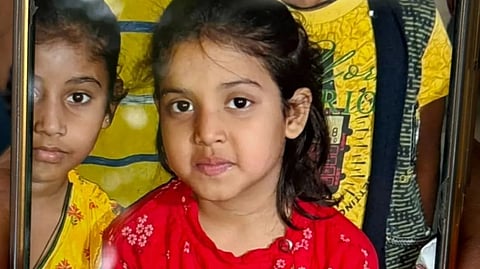

The death of 12-year-old Priyanshi, a student of a Delhi government school, beneath the wheels of a private school bus is far more than a tragic road accident. It is a grim reminder of the deep social and economic divide that defines life in the national Capital. The tragedy unfolded not merely because two vehicles collided but because two very different worlds met on the same road.
On one side was Priyanshi, the daughter of an economically underprivileged family, travelling to school in a rickety e-rickshaw, the only affordable mode of transport available to countless children studying in government schools. On the other was a bus belonging to a private school, transporting children whose families could afford a safer, more organised commute. Both vehicles carried children with dreams of a better future. Yet only one reflected the privilege of security, while the other exposed the vulnerability of poverty.
The image of the two vehicles colliding has become a powerful metaphor for contemporary Delhi. The city may be India’s political capital but it increasingly resembles two parallel societies existing side by side. One enjoys the protection of institutional resources and better infrastructure and the other struggles every day against the odds simply to access education.
The aspiration of poor families to educate their children has always been one of India’s greatest strengths. Parents make extraordinary sacrifices to keep their children in school, convinced that education remains the surest path to social mobility. But for thousands of such families in Delhi, the journey to school itself has become fraught with danger. Safe transportation remains a privilege rather than a right.
Sadly, the threats confronting schoolchildren do not end on the road. India has witnessed several horrifying incidents where children have been sexually assaulted or murdered either while travelling to school or even within supposedly secure educational institutions. The murder of seven-year-old Pradyuman Thakur inside a reputed private school in neighbouring Gurugram in 2017 continues to haunt the nation’s collective conscience. Delhi, too, has repeatedly reported cases of sexual abuse involving schoolchildren, reinforcing the uncomfortable truth that classrooms alone cannot guarantee a child’s safety.
Against this backdrop, the Delhi government’s initiative ofAbhivavakShikshakSamvad (parent teacher dialogue) deserves appreciation. By bringing parents and teachers together to discuss the Protection of Children from Sexual Offences (POCSO) Act, cyber safety and child protection, the Directorate of Education acknowledges that schools today have responsibilities extending far beyond academics. Such initiatives encourage parents to recognise early signs of abuse or distress.
However, awareness programmes cannot become the end of policy. They must serve as the beginning of a much larger social intervention. The present Delhi government has invested substantially in improving infrastructure in government schools. However, improved infrastructure has also raised expectations. People now expect the government to ensure not only quality education but also the safety and well-being of every child connected to the public education system.
The next phase of educational reform must therefore move beyond bricks and mortar. It must focus on what may be called the social ecosystem of education. Every child should be closely mentored, emotionally supported and protected throughout the educational journey.
Counsellors, teachers, community volunteers and local administrations should work together to identify vulnerable children before they become victims of neglect, crime or social alienation. Such investment is not welfare but nation-building, which the current government so strongly propounds. Children who grow up feeling protected and valued are far less likely to develop grievances against society and far more likely to become responsible citizens.
Priyanshi’s death should not become another headline that fades with the next news cycle. It should become the catalyst for reimagining what educational justice truly means. Education cannot begin at the school gate and end with examination results. It begins the moment a child steps out of home and continues until that child returns safely at the end of the day.
Sidharth Mishra,
Author and president, Centre for Reforms,
Development & Justice
