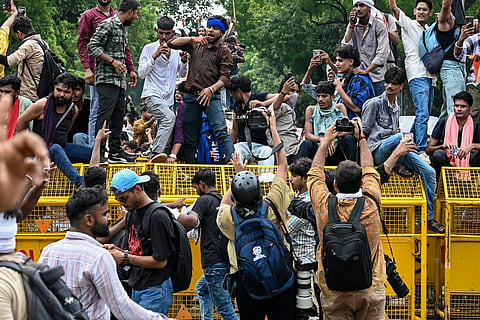

Nearly a decade and a half after the Anna Hazare movement transformed India’s political discourse, another wave of public protest has captured national attention. The parallels are obvious, yet beyond the surface similarities lies a profound difference. This new movement was less choreographed, less structured and for precisely that reason, more powerful.
The students’ movement compelled the government to bring a new law to fast-track exam paper leak cases, reform examination agencies, ensure accountability through the minister’s resignation and transfer senior bureaucrats. The government has also promised further measures to address students’ concerns.
The anti-corruption movement led by Anna Hazare in 2011 was more of a well organised political event. The organisers understood the power of symbolism. They distributed the now-iconic white acrylic caps emblazoned with the words “Main Bhi Anna” (I am Anna), instantly transforming thousands of ordinary citizens into participants of a shared national campaign.The cap conveyed solidarity, purpose and discipline.
This time, however, there was no matching caps, no identical T-shirts, no printed banners handed out by organisers and no visible attempt to create a standardised appearance. At first glance, this may suggest a lack of planning but since this movement was considerably less organised than Anna Hazare’s, its more organic.
The Anna movement, despite its scale, was never truly tested by sustained confrontation with the state. Political engagement intervened before such a moment arrived. Then Union Minister Vilasrao Deshmukh, himself from Maharashtra like Anna Hazare, played a crucial mediatory role. Negotiations succeeded in ending the fast before the situation escalated.
This summer’s protests have followed a different trajectory. The initial response from the establishment was tough and administrative, treating it primarily as a law-and-order challenge. That approach proved to be counter-productive as the movement came to acquire an identity.
Human beings seek symbols that express collective purpose. If one looks closely at the present protests, a subtle form of uniformity did come to exist in the symbol of the backpack.First this may have seemed incidental but the backpack has become the defining visual of this generation’s protesters.
Backpackers are typically independent travelers. They travel light, spend cautiously, rely on public transport and carry everything they need in a single bag. They are self-sufficient, flexible and constantly prepared to adapt.The same description remarkably fitted these protesters.
They traveled by metro, buses and shared transport. They carried water bottles, food packets, rain protection, power banks, medicines, laptops, books and personal essentials inside their backpacks. Their bag was not merely luggage but a portable home, enabling them to spend long hoursaway from conventional comforts.
More so, like backpackers exploring unfamiliar landscapes, these young protesters voluntarily entered uncertain political terrain.The challenges they confrontedwere not mountains, forests or deserts butan equally difficult landscape, a political monolith that initially looked reluctant to engage with dissent.
There was another similarity between travelers and protesters.Neither knew exactly what lay ahead. They continued because remaining stationary seemed a greater compromise than moving forward.The backpack, therefore, symbolised mobility, resilience and personal responsibility.
Unlike the distributed caps of 2011, no organisation manufactured this identity. It emerged naturally because it reflected the lived realities of those participating.Perhaps that made it even more authentic.
The backpack generation—Gen Z or the Instagram generation—announced its arrival through this protest. Though it lacked coordinated slogans or a towering leader, its quiet unity spoke volumes.
Sidharth Mishra
Author and president, Centre for Reforms, Development & Justice
