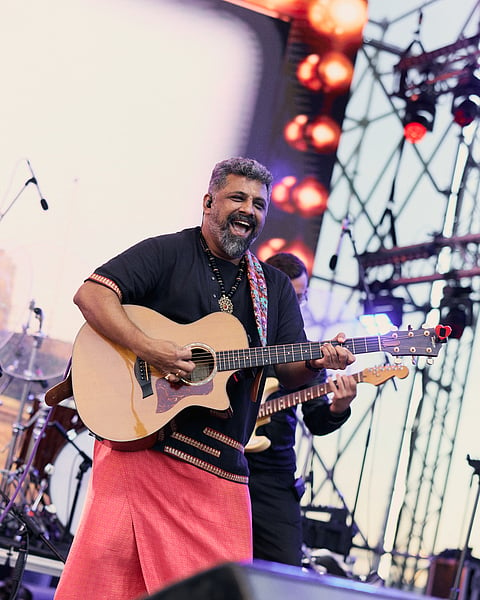

Barefoot, dressed in his signature colourful veshti with ankle bells—a nod to his Bharatanatyam training—and a guitar slung across his shoulder, the indie musician Raghu Dixit has been captivating listeners for nearly 30 years. It is a fitting image of an artist who has spent decades taking Indian folk traditions to audiences across the world. This month, Dixit returns to Delhi as part of the South Side Story festival. “We're coming with a completely new set,” he says.
For the Bengaluru musician, Delhi has always been one of his favourite cities to perform in. “India Habitat Centre used to be my favourite place to perform when I first started my career, apart from the various college festivals,” he says, adding that a visit to Paranthe Wali Gali is almost always on the itinerary. He will take the stage with The Raghu Dixit Project at K. D. Jadhav Indoor Hall in Delhi on August 29.

Taking folk global
Last month the musician was in St. Petersburg, Russia, where he performed at the EtoEtno Festival, a celebration of global folk and ethno-fusion music, after an invitation from Serbian multi-instrumentalist Slobodan Trkulja.
“There were musicians from Bulgaria, Syria, Mongolia, China, Uzbekistan, Russia and many other countries,” recalls Dixit, the only Indian artist at the festival. It was his first visit to Russia, an experience he describes as "very special".
From Russia, Dixit travelled to London, performing at the South Asian Sounds Festival at the Southbank Centre and Queen Elizabeth Hall—a venue that brought back memories of his earlier appearances at the Alchemy Festival. “There was a great crowd, especially a lot of Kannada people. They eventually sabotaged my setlist and I ended up singing the songs they wanted. It was great fun.”
Joining him on the London stage was The Raghu Dixit Project, the folk-rock ensemble he founded in 2006 after his earlier band Antargni disbanded. Nearly two decades later, the band's current lineup, he says, has remained together for almost ten years. “We've become family. We travel together, work hard together, have fun together and make music together,” says Dixit.
Today, he says, the band has grown beyond its name. “I want to take everyone with me instead of making the journey just my own. The Raghu Dixit Project is almost a misnomer now because everyone is such an equal participant in it,” he adds.
A love letter to amma
One of the band's defining moments came during its 2011 UK tour, where they performed at Glastonbury, appeared on the BBC's Later... with Jools Holland, and even performed for the Queen of England.
"It was every musician's dream to perform at Glastonbury," he says.
Following the tour, while writing down the names of everyone who had helped him reach that point, he realised he had forgotten to mention the one person who mattered most—his mother. “I called her crying and apologised,” he recalls. “She just told me, ‘Come back home, have some food and you'll be fine.’”
Years later, that memory became the heart of 'Amma', released this May as a Mother's Day tribute. Describing it as “a love letter to the love my mother gave me to become an artist”, Dixit says the song was originally written in Tamil by lyricist Madhan Karky as part of his album Jag Chanda. For years, Kannada-speaking fans urged him to record it in their language. “I kept gatekeeping the song because it was very personal,” he laughs.
During the pandemic, while separated from his mother, he decided to rewrite it in Kannada with lyricist Pramod Maravante. “Unfortunately, my mother wasn't around to hear it. But this version is for all the fans and their mothers,” he says. The track ‘Amma’ is now being adapted into Telugu, with a remastered Tamil version set to be released soon.
Singing in Kannada, Tamil, Telugu, Hindi and several other languages, Dixit believes language should never become a barrier. "Whenever I perform somewhere new and speak even a few words in the local language, people light up," he says. "If language is the thing separating us, why keep the barricade up? I might as well break it."
He is currently teaching himself Telugu, Hindi, and other languages with the hope of connecting more deeply with audiences across India, and eventually hopes to learn foreign languages like Spanish for performances abroad.
The next chapter
Beyond music, Dixit has been equally vocal about mental health, supporting initiatives such as Manodani and Glass Onion Therapy. His 2024 album Shakkar emerged from a deeply introspective phase, shaped in part by therapy and conversations about purpose.
He recalls one such conversation with his therapist, who asked him what his ultimate ambition was. “I said maybe a Grammy,” he smiles. “She picked up a flask from the table and said, ‘That's your Grammy. Now what?’” The exercise forced him to rethink what success meant. “I realised I didn't have a purpose behind my music. I was selfishly looking at myself.”
Nearly three decades years after first stepping onto a stage, Dixit is in no hurry to conquer the world. Having never formally trained in music, he is now studying it from scratch, hoping to collaborate with more musicians across the world and continue learning.
“I don't have any big dreams anymore,” he says. “I just want to be happy doing what I do. And I'd be even happier if what I do makes other people happy.”