
By Huzaiful Reyaz
What is a poet, really? Not the textbook definition, but the real answer—a poet is the person a civilisation deputises to feel on its behalf. When a whole society cannot articulate its longing, its shame, its tenderness, its fury, it produces, almost involuntarily, one person who can. That person carries the emotional weight of millions who will never know his name. He feels for them. He words for them. He aches, publicly and precisely, so they do not have to ache alone and wordless in the dark.
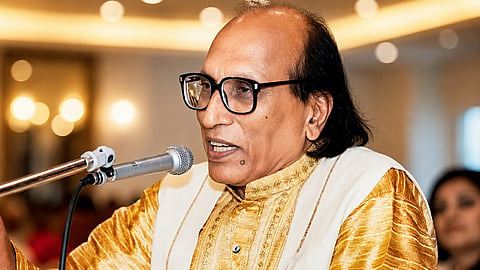
Bashir Badr was that person for the Urdu-speaking world, and far beyond it, for nearly seven decades. On May 28, he died in Bhopal at 91. And the civilisation he spent his life serving is only now, in the particular clarity that grief sometimes forces open, beginning to understand what it had.
He was not merely a great poet. His was a great act of memory. Every verse he wrote was an act of preservation against a world trying, steadily and successfully, to destroy the interior lives of ordinary people. Classical Urdu poetry before his generation was magnificent and completely inaccessible. Encrusted with Persian aristocracy, built for courts and scholars, breathtaking and sealed behind a door that the man on the street was never given a key to. Badr looked at that door, and he took it off its hinges. He wrote in the language of the person who had loved and lost and to whom the world said his feelings were too small for verse. He said: Your feeling is not small. Your feeling is as old and as large as any feeling that has ever existed.
Zindagi tu ne mujhe qabr se kam di hai zamin
Paanv phailaun to diwar mein sar lagta hai
(Life, you have given me even less land than a grave. When I stretch my legs, my head hits the wall.)
Not one Persian flourish. Not one word requiring a dictionary. A man lying down in the smallness of his existence and measuring its walls with his own body. A rickshaw-puller has felt that. A professor at 3 am has felt that. A young woman in a small room, loving someone she cannot have, has felt that. That was his genius: not complexity but a precision so ruthless it felt like intimacy.

A new direction
Bashir Badr was born in Faizabad in 1935, the city later renamed Ayodhya—perhaps the most contested name in the modern history of this subcontinent. From that particular wound in the geography of belonging came a man who spent his entire life building the opposite of what his birthplace had come to represent. He was seven years old when he began writing poetry. Before Partition, before independence, before the map of everything he knew was torn in half, a child in Faizabad decided that the language around him was insufficient for what he felt. That refusal never left him.
What he did to the Urdu ghazal is what a river does when it finds a new course. It does not announce itself. It simply moves, and the landscape reorganises itself around the fact of its movement. He stripped the ghazal of its dense Persian ornamentation and gave it instead the conversational Hindustani idiom that crossed every border the subcontinent had drawn. Religious borders. Class borders. The border between the literary and the lived. He dissolved the wall between Hindi and Urdu ghazal so completely that today you can barely find where it once stood.
This was a political act disguised as a stylistic choice. He was saying, in every poem, that the inner life of an ordinary person deserves the same metaphysical seriousness as the inner life of a king. That grief is not diminished by poverty. That longing does not become less real when the person feeling it cannot read Persian. Javed Akhtar has said that Urdu has become a little poorer. The truth is larger than that. The language that Badr dragged out of the courts and into the streets and into the hearts of people who had never been told their hearts were worth writing about, lost today the man most responsible for its survival in living memory.
At Aligarh Muslim University, an incident occurred that should be told at the beginning of every conversation about genius and the world’s hostility to it. A young Bashir Badr sat before an examiner for his viva. The examiner challenged his interpretation of a couplet. Badr disagreed. They argued. Badr failed. What the university records did not preserve was the one fact that transforms the entire meaning of the story.
Bashir Badr had written the couplet himself. He was failed for the wrong interpretation of his own poem. He was marked incorrect for the meaning of lines that lived inside him before they lived anywhere else in the world. This is not a charming anecdote. This is the central parable of his life, and perhaps of every original mind that has ever existed in a world that only recognises originality after it has been safely dead long enough to stop being threatening. Then came 1987. Communal riots tore through Meerut. His house was burned. His manuscripts, his books, his unpublished work, poems that existed nowhere in the world except on those pages and inside him, turned to ash in a fire lit by the exact hatred his most famous couplet had spent 15 years trying to prevent.
Dushmani jam kar karo lekin ye gunjaish rahe
Jab kabhi hum dost ho jaayein to sharminda na hon
(Even if we are enemies, leave this room: that if we become friends one day, neither of us is ashamed)
Sorrowing, surviving, writing
He had written that in 1972. Fifteen years later the rioters came. They did not read poetry. They burned it. And Bashir Badr packed what remained and moved to Bhopal. And then he sat down and wrote more poems. Not poems of rage. Poems of sorrow, of survival, of the stubborn insistence on human tenderness in the face of human savagery. His grief became public property. His loss became the vocabulary other people reached for when they needed words for their own losses. There is no political term for that kind of soul. There is only the word Bashir Badr spent his whole life writing around: mohabbat.
The river does not end. But the river is gone.
Here is the philosophical cruelty at the centre of his fame. He became so embedded in the emotional life of this civilisation that the civilisation forgot he had built it. Narendra Modi quoted him. Zulfikar Ali Bhutto quoted him. Mallikarjun Kharge quoted him. The film Masaan carried his verses into cinema halls where young people wept without knowing whose words were moving them. Both sides of a border that has drawn blood for 78 years are quoting him today in the same hour of mourning. When India and Pakistan grieve the same man simultaneously, he was writing not for a nation but for the human condition itself.
And yet countless people sent his lines to those they loved as though the lines had always existed, as though no specific human being had sat somewhere in the particular loneliness of creation and suffered them into existence word by word. He became anonymous through excellence. The better he was, the more invisible he became. Then came the second erasure, slower and more intimate than the first. Dementia. Year by year in that quiet house in Bhopal, the memories left him. The mushairas. The examiner who was wrong. The burning house. The faces of his children. And the verses. In his final television appearance in 2018, he could not recall his own poems.
Sit with that. Do not move past it quickly. The man who wrote:
Ujaale apni yaadon ke hamaare saath rehne do
Na jaane kis gali mein zindagi ki shaam ho jaaye,
(keep the lights of memory with me, who knows in which street life’s evening may descend)
sat in a room he did not recognise and could not find the lights.
What happened to Bashir Badr is what is happening to Urdu itself. A language of extraordinary emotional precision. A language that evolved over centuries to name the shades of longing and the varieties of loss that no other vocabulary on this subcontinent could reach. Being forgotten. Being quoted without credit. Mourned loudly by a world that quietly allowed it to disappear from schools and the official record. The poet and the language share one fate. Both gave everything. Both were taken for granted. Both are mourned today with an intensity that has arrived, as it so often does, exactly one day too late.
Huzaiful Reyaz is a Delhi-based independent researcher whose work explores the intersections of religion, politics, and history.